
2026-08-26 · Article
People Will Take the Bot. They Cannot Find the Door.
A company that sells AI customer service agents published the research showing people yell and swear to escape one. The complaint is not the machine. It is the missing exit.
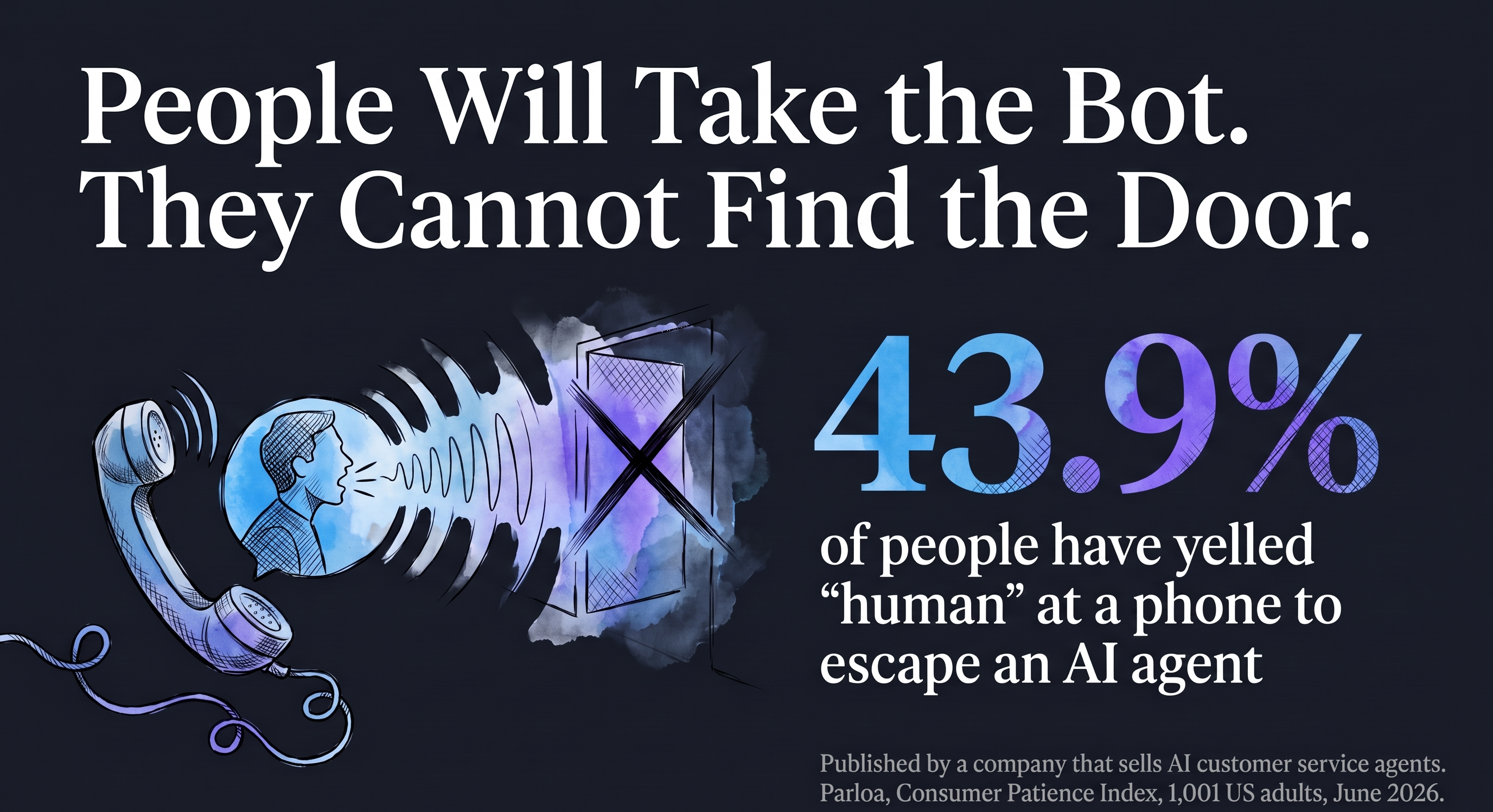
On 22 June 2026, a company that builds and sells AI agents for customer service published a study showing that 43.9 per cent of the people who had recently contacted a company's customer service department had tried yelling "human" or "person" to escape an automated system. Seventeen per cent, roughly one in six, had resorted to profanity.
Parloa is the company. Parloa sells agentic AI for customer service. The research is the Consumer Patience Index, commissioned by Parloa and conducted by independent firm Propeller Insights, which fielded it in spring 2026 across 1,001 US adults who had contacted a company's customer service department in the previous twelve months. It was published via PR Newswire on 22 June 2026. You may draw your own conclusion about a vendor publishing that.
The familiar reading of those numbers is that they confirm what the industry has long argued: people do not want to talk to bots. That is a reasonable argument and there is data behind it. An AnswerConnect/OnePoll survey of 6,000 people across the US, UK and Canada, fielded in April 2026 against an October 2025 baseline, found that the proportion saying they prefer a real person had risen from 83 to 85 per cent, and that frustration with AI agents had climbed from 54 to 59 per cent. AnswerConnect sells human-staffed answering services, which does not make the finding wrong, but does make it unsurprising.
That two vendors with directly opposing commercial interests produce numbers pointing the same way is harder to dismiss as one party's marketing. The caveat stands: both are vendor-commissioned surveys of self-reported feeling, both rely on people recalling their own frustrations, and a shared methodology can produce a shared direction of bias. The agreement is reason to take the direction seriously. It is not proof.
What the Parloa data actually answers is not whether people want bots. It is what they want instead.
Parloa asked respondents to rank their most frustrating experiences in customer service. Talking to a bot that did not understand them came first, cited by 25.9 per cent. Long hold times ranked second at 22.8 per cent. Multiple transfers came third at 13.4 per cent. Being forced to repeat information came fourth at 12.2 per cent. Speed is not on the list. The complaint is that the machine does not understand, and that when it reaches its limit, getting somewhere useful is not straightforward.
Notice what is conspicuously absent: automation itself. The machine is not the grievance. Being stuck is the grievance. Three of the four top complaints are versions of the same problem: the bot that cannot understand you, the transfer that sends you somewhere you have already been, the instruction to repeat yourself to a new agent. The machine reached the boundary of what it was built for, and nobody designed what happens next.
The three-minute finding makes this concrete. In the Parloa survey, 55.5 per cent of respondents said they would interact with an automated system for less than three minutes before asking for a human. Not hang up. Not abandon the brand. Ask for a human. The majority, within three minutes, looks for a door.
Our reading is that these respondents are not rejecting automation full stop. The survey records the behaviour, not the reason. But set the behaviour next to the pain points and a pattern appears: the bot cannot go where these callers need to go, and when it cannot, the exit is not obvious. The shouting is a workaround. The profanity is a user-interface problem.
The counterweight to all of this is also in the Parloa data, and it belongs in this article.
Eighty-five per cent of those same 1,001 respondents said they were very or somewhat likely to embrace an automated system that resolved their issue nine times out of ten. Forty-four per cent said they cared only about the result, not whether AI or a human delivered it. The 43.9 per cent who had yelled at the system and the 85 per cent willing to embrace it are not separate populations. Many of them are the same people: fine with the machine when it works, looking for a human when it does not.
That is not a rejection of automation. It is a specification.
The supporting surveys from late 2025 fill in the same picture. Glance's 2026 CX Trends report, based on 600-plus US consumers and released in December 2025, found that 75 per cent of respondents had received a fast AI-driven response that still left them frustrated. A SurveyMonkey survey of 2,017 US adults from the same month put human preference at 79 per cent and belief that human representatives are more accurate at 84 per cent. Both are vendor-published, and both carry the same self-report caveat. Speed without resolution is not a feature. It is a faster way to arrive at the same stuck place.
Nearly one in three respondents in the Parloa survey said they would switch brands entirely to avoid being put on hold in future. Not as a point of principle about AI. Because waiting failed them, and they have made a practical decision about where they take their business.
In the AnswerConnect survey, 31 per cent of the 6,000 respondents said they would hang up if connected to an AI at all. That sits alongside the 85 per cent who prefer a real person. But a preference for humans and a willingness to accept a capable machine are not in conflict. They express the same expectation: get me to a resolution, by whatever means gets there.
Across these four surveys, people are not angry about being served by a machine. They are angry about not being resolved, and about not being able to get out when the machine reaches its limit. That is our reading. The surveys record actions and stated preferences; none of them records the reasoning behind those preferences. But the pattern holds across sources with competing commercial interests, which is reason enough to treat it as a working hypothesis rather than noise.
Which brings us back to the 22 June 2026 press release.
Parloa published primary research, conducted by an independent firm with a stated methodology and sample, showing that nearly half of the people using products in their category had tried to shout their way out of them, and that the most common complaint was being misunderstood rather than automated. That research is publicly available. The findings it contains are not hidden from the people who build the systems.
The problem the industry is trying to solve is not whether people will accept AI in customer service. Eighty-five per cent of them say they will, provided it resolves their issue. The problem is whether the machine can get them somewhere, and what happens to the people who need somewhere it was never built to go.
The next article in this series follows a bank that cut 45 customer service roles because a voice bot had reduced its call volumes, and then confirmed, weeks later, that the decision had been incorrect.
Sources
| Claim | Source | Checked |
|---|---|---|
| 43.9 per cent tried yelling "human" or "person"; 17 per cent resorted to profanity; 55.5 per cent ask for a human within three minutes; nearly one in three would switch brands to avoid being put on hold; 85 per cent likely to embrace automation that resolves nine times out of ten; 44 per cent care only about the result | Primary. Parloa, Consumer Patience Index, released 22 June 2026 via PR Newswire. Commissioned by Parloa, conducted by Propeller Insights, fieldwork spring 2026, n = 1,001 US adults 18+ who had contacted customer service in the prior 12 months | 2026-08-24 |
| Pain points ranked: bot that does not understand 25.9 per cent, hold times 22.8 per cent, transfers 13.4 per cent, repeating information 12.2 per cent | Primary. Parloa, Consumer Patience Index, 22 June 2026 | 2026-08-24 |
| Human preference 83 to 85 per cent; AI preference 7 to 5 per cent; frustration 54 to 59 per cent; would hang up 29 to 31 per cent; trust 53 to 57 per cent; service would worsen 65 to 70 per cent; loyalty 69 to 73 per cent | AnswerConnect / OnePoll, n = 6,000, US, UK and Canada, surveyed April 2026 against an October 2025 baseline | 2026-08-24 |
| 75 per cent frustrated by a fast AI response; a third said AI made things harder; nearly 90 per cent reported reduced loyalty when human support was removed | Glance, 2026 CX Trends, 600+ US consumers, December 2025 | 2026-08-24 |
| 79 per cent prefer human service; 84 per cent believe humans more accurate | SurveyMonkey, 2,017 US adults, December 2025 | 2026-08-24 |
Correction carried. An earlier draft of this article stated that more than half of respondents would abandon a service after three minutes of automation. The Parloa study says 55.5 per cent will interact with an automated system for less than three minutes before asking for a human. That is a different finding and the article has been rewritten around the correct one. It also gave the study's date as April 2026; it was published on 22 June 2026.
Interests declared. Parloa sells agentic AI for customer service. AnswerConnect sells human-staffed answering services. Glance and SurveyMonkey sell customer-experience software and survey software. Two of the sources here have directly opposing commercial interests and their findings agree, which is the reason to trust the direction rather than any single number. And ours, plainly, because this series asks you to check who paid for every number you are shown. Tech Sight advises buyers on contact-centre automation. We also sell in this market: agentic AI for document understanding and document intelligence, intelligent chatbots, and an equity interest in Kobliat, an intelligent contact-centre platform owned by a separate company. That puts us in the same category as several of the vendors cited above, including one whose research this article is built on. We have published their numbers rather than ours, and every figure here is traceable to a named source with its methodology stated, so that you can check us the way we are asking you to check them.
Stated as opinion, not finding. That the shouting is a workaround for a missing exit rather than a rejection of automation is our reading of these numbers, not a claim any of the surveys makes.
Correction policy: if we have misread a figure or a sample, tell us and this article will carry the correction and the citation at the top.
Book the two-hour diagnostic