
2026-08-26 · Article
The 45 Jobs That Were Not Redundant
A bank cut 45 customer service roles because a voice bot had reduced call volumes. The union said volumes were rising. Nobody has established the technology underperformed at all.
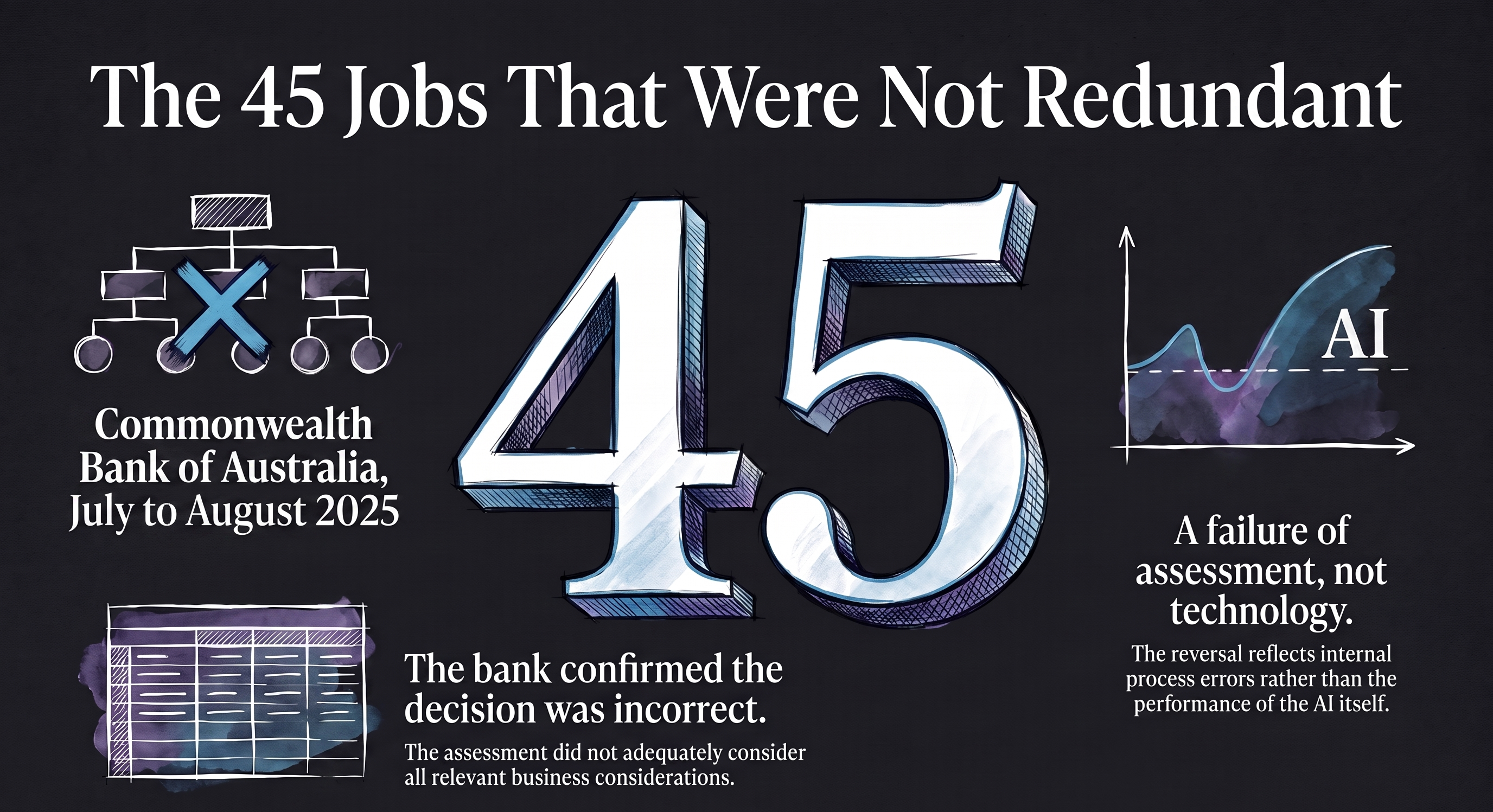
In July 2025, Commonwealth Bank of Australia told 45 people in its Customer Service Direct business that their roles no longer existed. An AI voice bot had taken the calls. CBA said the technology was reducing call volumes by 2,000 a week, that its investment in AI was 'making it easier and faster for customers to get help, especially in our call centres.' Some of those 45 had been with the bank for decades.
By 21 August, CBA confirmed the decision was incorrect.
The bank's own wording is worth reading carefully, because the easy version of this story and the true version are not the same. CBA did not say the bot had failed. A spokesperson said the initial assessment of the roles 'did not adequately consider all relevant business considerations and this error meant the roles were not redundant.' The bank said it was reviewing its internal processes. The affected staff were offered a choice: stay, seek redeployment, or proceed with leaving.
The Finance Sector Union had taken CBA to the Fair Work Commission in August, arguing the bank was not being transparent about call volumes. The union's account was less diplomatic. 'Call volumes were rising,' said the FSU, 'with management scrambling to offer overtime and even pulling team leaders onto the phones.' FSU national secretary Julia Angrisano called the reversal 'a massive win for workers' and, in the same breath, 'this is no victory lap.' The bank had been 'caught out trying to dress up job cuts as innovation,' she said. The union called it the 'tip of the iceberg.'
Nobody has established that the voice bot underperformed. The Register noted the day after the reversal that it remains unclear whether the AI itself underperformed or whether the bank miscalculated something else. Those are different problems with different solutions. The bank's own statement describes the second one. The assessment of the roles did not adequately consider all relevant business considerations. The assessment is a set of assumptions and projections; the technology is a separate thing entirely, and the coverage that collapsed this distinction missed what actually happened.
Which raises the obvious question: did anyone have reason to expect the answer might be different?
Three months before CBA announced the cut, a research firm called Orgvue published findings from a survey of 1,163 C-suite and senior business leaders in the US, Canada, UK, Ireland, Australia, Hong Kong, Malaysia and Singapore. Fieldwork had run from February to March 2025. The finding: 39 per cent of those leaders had made employees redundant as a result of deploying AI. Of that group, the leaders who had actually made the cuts, 55 per cent said the decision was wrong.
The denominator matters here, so let us be exact. The 55 per cent is not 55 per cent of the 1,163 leaders surveyed. It is 55 per cent of the 39 per cent who had made AI-driven redundancies. Of the people who had been there and done it, more than half said they should not have.
Oliver Shaw, CEO of Orgvue, on 29 April 2025: 'While 2024 was the year of investment and optimism, businesses are learning the hard way that replacing people with AI without fully understanding the impact on their workforce can go badly wrong.'
This was on the wire in April. We do not know what anyone at CBA read. What we can say is that the information was not missing.
One other thing about that figure. HR Dive reported the same research at 40 per cent, not 39. One percentage point, one outlet, one rounding from primary to secondary. Nothing turns on a single point here. But this is a series about numbers that do not survive checking, and a one-point drift in a piece about AI workforce decisions is the kind of thing worth naming once.
The bigger picture is less dramatic than the coverage suggests, and it matters for context. Gartner surveyed 321 customer service and support leaders in October 2025. About 20 per cent had actually reduced agent headcount because of AI. The majority had kept headcount steady, even as they were supporting more customers. Both halves of that finding are Gartner's. In February 2026, Gartner published a prediction: by 2027, 50 per cent of companies that attributed headcount reduction to AI will rehire staff to perform similar functions, under different job titles.
Kathy Ross, Senior Director Analyst at Gartner's Customer Service and Support practice: 'While AI-driven layoffs have captured attention, the reality is more complex. Most recent workforce reductions were influenced by broader economic conditions rather than automation alone.' Post-pandemic over-hiring. Cost restructuring. Economies correcting. Emily Potosky, also at Gartner, was more direct: 'AI simply isn't mature enough to fully replace the expertise, empathy, and judgement that human agents provide.'
The secondary evidence of rehiring follows a similar shape. Robert Half surveyed more than 2,000 US hiring managers in April 2026 and provided the data to CNBC. Of those who had cut a role primarily because of AI, 32 per cent had rehired for the same or a similar position. Finance: 44 per cent. HR: 35 per cent. Robert Half is a recruitment firm with a commercial interest in rehiring, and this figure reaches us via a single outlet rather than a published report. Treat it as directional.
Ford is reported to have rehired, hired or promoted 350 experienced engineers after automated quality control could not replicate veteran engineering judgement. Ford also topped J.D. Power's 2026 Initial Quality Study for the first time since 2010. These are two separate reported facts from secondary coverage, and no source we hold connects them causally. IBM's AskHR system is reported to handle about 94 per cent of routine HR queries; the remaining 6 per cent still needs a person. IBM is also reported to have announced plans to triple US entry-level hiring in 2026. Klarna's CEO, Sebastian Siemiatkowski, conceded the company had focused 'too much on efficiency and cost.' That is what he said.
None of this is a story about technology that could not perform. The pattern is narrower and more useful, and our reading of the bank's own wording is that the business case was never checked against what was happening on the ground.
CBA's statement says the assessment 'did not adequately consider all relevant business considerations.' That formulation does not tell us what was not considered, and it would not be accurate to speculate. What the FSU was prepared to argue at the Fair Work Commission is that call volumes were moving in the opposite direction to the projection. Whether those two data sets were ever put next to each other before the decision is not something anyone has reported.
Article 1 of this series established that the complaint about contact-centre AI is not speed. It is not being resolved. The argument of this series is that a contact which is not resolved comes back, and comes back more expensive. The 45 people who were meant to be redundant were, on the union's account, exactly what the rising volume required: people who could answer the calls that were still arriving.
CBA noted it had recently announced a partnership with OpenAI. The bank said the reversal did not reflect on the technology. It may well not. What it reflected on, the bank has said only this: an assessment that did not adequately consider all relevant business considerations.
The bank is reviewing its internal processes. The 45 people are still making their choice. The next article asks who owns the numbers before that point, while a projection is still a projection and the gap between what the system handles and what it actually resolves has not yet started to widen.
Sources
| Claim | Source | Checked |
|---|---|---|
| July 2025: 45 customer service roles cut, replaced by an AI voice bot; bot said to have cut call volumes by 2,000 a week; CBA quote on making it easier and faster to get help | ABC News, Commonwealth Bank backtracks on AI job cuts, apologises for 'error' as call volumes rise, 21 August 2025 | 2026-08-24 |
| CBA confirmed the redundancy decision was incorrect; the assessment 'did not adequately consider all relevant business considerations and this error meant the roles were not redundant'; staff offered their roles back, redeployment or exit | ABC News, 21 August 2025; ACS Information Age, CBA reverses AI-driven job cuts, admits 'error' | 2026-08-24 |
| FSU took CBA to the Fair Work Commission over transparency on call volumes; 'Call volumes were rising, with management scrambling to offer overtime and even pulling team leaders onto the phones' | Finance Sector Union, via ABC News and ACS Information Age | 2026-08-24 |
| Julia Angrisano: 'a massive win for workers', 'this is no victory lap', 'caught out trying to dress up job cuts as innovation', 'tip of the iceberg' | FSU national secretary, via ACS Information Age and Slashdot | 2026-08-24 |
| Some of the 45 had been with CBA for decades; CBA said it was reviewing its internal processes | Finance Sector Union and CBA spokesperson, via ACS Information Age and ABC News | 2026-08-24 |
| It remains unclear whether the AI underperformed or the bank miscalculated something else; CBA had recently announced an OpenAI partnership | The Register, Bank reverses decision to replace 45 staff with chatbot, 22 August 2025 | 2026-08-24 |
| Bloomberg and TechRadar coverage of the reversal | Bloomberg, Australia's Biggest Bank Reverses Plan to Replace Jobs With AI, 21 August 2025; TechRadar | 2026-08-24 |
| 39 per cent made redundancies due to AI; of those 55 per cent admit wrong decisions; Oliver Shaw quote | Primary. Orgvue, 55% of businesses admit wrong decisions in making employees redundant when bringing AI into the workforce, 29 April 2025, via PR Newswire. Fieldwork Vitreous World, February to March 2025, n = 1,163 C-suite and senior leaders, US, Canada, UK, Ireland, Australia, Hong Kong, Malaysia, Singapore | 2026-08-24 |
| HR Dive reported the same research as 40 per cent | HR Dive, More than half of leaders who laid off workers due to AI admit to screwing up, 29 April 2025 | 2026-08-24 |
| 'By 2027, 50 per cent of companies that attributed headcount reduction to AI will rehire staff to perform similar functions, but under different job titles'; about 20 per cent of customer service leaders have reduced agent headcount due to AI; Kathy Ross and Emily Potosky quotes | Primary. Gartner press release, 3 February 2026, based on a survey of 321 customer service and support leaders, October 2025; as reported by TechRepublic, 2 March 2026 | 2026-08-24 |
| Robert Half: 32 per cent of US hiring managers rehired for the same or a similar role; finance 44 per cent, HR 35 per cent, technology 32 per cent | Robert Half survey of 2,000+ hiring managers, April 2026, data provided to CNBC, Employers who laid off workers citing AI are already starting to regret it, 1 July 2026 | 2026-08-24 |
| Ford rehired, hired or promoted 350 experienced engineers; subsequently topped J.D. Power's 2026 Initial Quality Study for the first time since 2010 | Secondary. Coverage of the 2026 rehiring wave, including CNBC, 1 July 2026, and Forbes, 26 July 2026. No primary Ford statement obtained | 2026-08-24 |
| IBM AskHR handles about 94 per cent of routine HR queries; IBM to triple US entry-level hiring | Secondary. Coverage of the 2026 rehiring wave. No primary IBM statement obtained | 2026-08-24 |
| The finding that the leading complaint is comprehension rather than speed | Tech Sight, The Deflection Gap, article 1, drawing on Parloa's Consumer Patience Index, 22 June 2026 | 2026-08-24 |
| Klarna CEO conceded a focus 'too much on efficiency and cost' | Sebastian Siemiatkowski, via Bloomberg interview coverage, May 2025 | 2026-08-24 |
Where we relied on secondary sources. The Orgvue and Gartner findings are from the primary releases, with methodology and fieldwork dates stated above. The Robert Half figure is from data the firm provided to CNBC rather than a published report we obtained. The Ford, IBM and Klarna items reach us through reporting on the 2026 rehiring wave; we have not obtained primary statements from those companies and have written them as reported.
Stated as opinion, not finding. That the business case rather than the technology was the thing that went unchecked is our reading of CBA's own wording. The bank has not said this, and nobody has published an assessment of how the voice bot itself performed. That the Orgvue research constituted an available warning is also our reading; Orgvue did not address CBA and CBA has not said what it read.
Interests declared. The FSU is the union representing the affected workers. CBA is a bank that had recently announced an AI partnership. Orgvue sells organisational design software and Gartner sells research, so both have a commercial interest in the workforce-planning problem they describe. Robert Half is a recruitment firm and therefore has an interest in rehiring. And ours, plainly, because this series asks you to check who paid for every number you are shown. Tech Sight advises buyers on contact-centre automation. We also sell in this market: agentic AI for document understanding and document intelligence, intelligent chatbots, and an equity interest in Kobliat, an intelligent contact-centre platform owned by a separate company. That puts us in the same category as several of the vendors cited above, including one whose research this article is built on. We have published their numbers rather than ours, and every figure here is traceable to a named source with its methodology stated, so that you can check us the way we are asking you to check them.
Correction policy. If we have misread a figure, a quote or a date, tell us and this article will carry the correction and the citation at the top.
Book the two-hour diagnostic