
2026-06-30 · Article
Shield Up
Five governance pillars were not enough. June 2026 demanded a sixth.
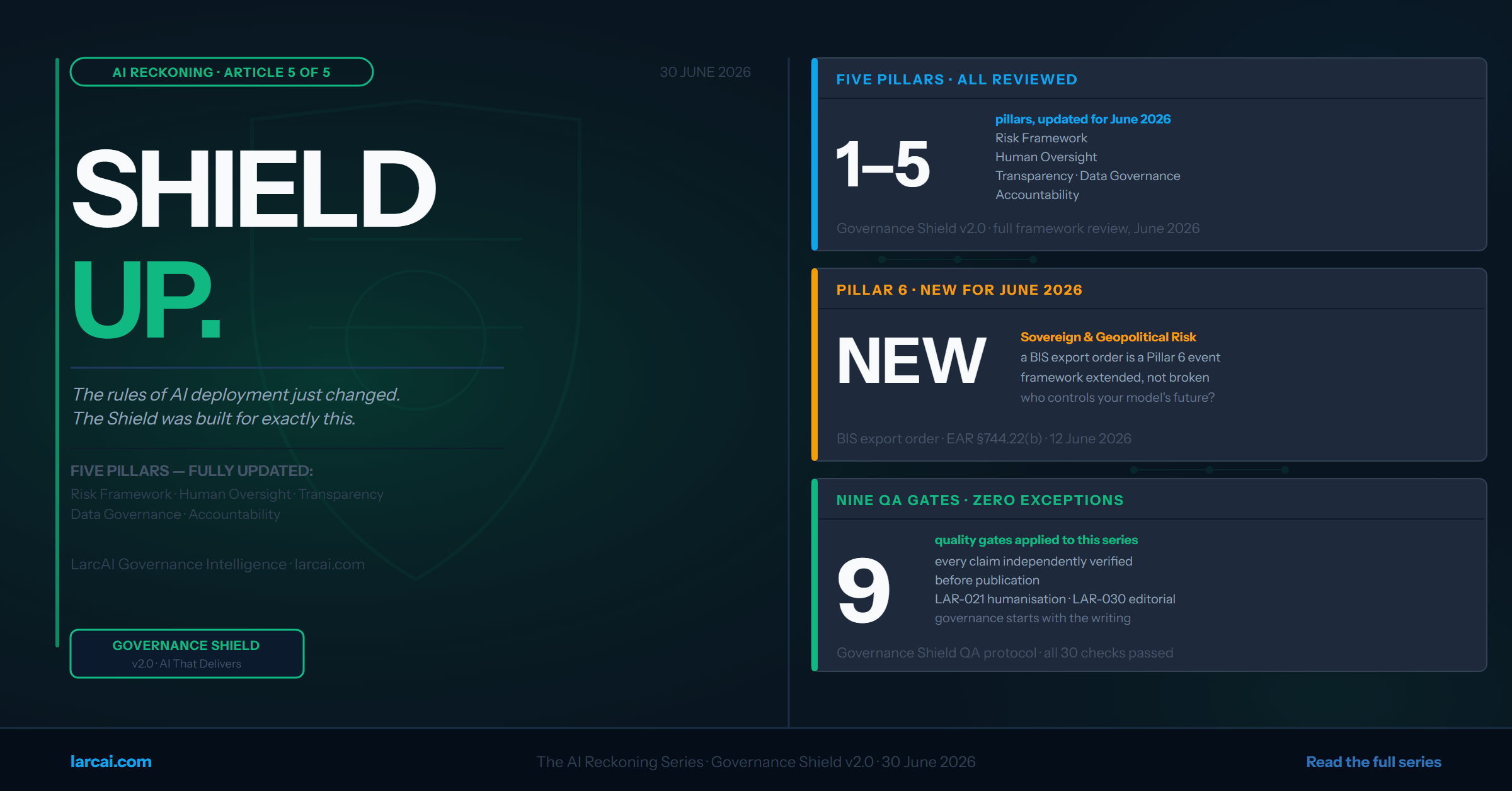
The governance framework the moment demands: introducing Governance Shield v2.0
Four articles in, the picture is not complicated. AI in June 2026 is more regulated, more financially pressured, and more geopolitically contested than anyone's 2024 strategy assumed. None of that changes what AI can do for your organisation. It changes what you need to do before you deploy it.
This article is about what to do.
The Governance Shield framework has guided enterprise AI deployments since its first version. The events of this fortnight have made a revision necessary, not because the original framework was wrong, but because the risk exposure has expanded in a way that requires an explicit response. This is Governance Shield v2.0.
What Remains: The Five Original Pillars
The five original pillars remain intact and mandatory. Nothing that happened this fortnight made them less relevant.
Pillar 1, Anti-Hallucination Architecture, requires that every AI response be grounded in verified source data, with confidence scoring, explicit uncertainty protocols, and automatic human escalation below confidence thresholds. Hallucination tolerance is zero. Vendors under competitive and regulatory pressure are less likely, not more, to invest in conservative output calibration. Build it in yourself.
Pillar 2, Complete Audit Trails, requires that every AI decision be logged with inputs, reasoning, and outputs, with seven-year default retention and export capability for compliance tooling. When access changes suddenly, you need a complete record of every decision made with every capability level.
Pillar 3, Data Protection, addresses encryption, access controls, PII masking, and data sovereignty. The v2.0 update adds Vendor Continuity Assurance: a formal requirement that data processed by AI systems is exportable and recoverable independent of vendor continuity. The financial pressures described in article three make this material, not theoretical.
Pillar 4, Regulatory Compliance, covers POPIA, GDPR, HIPAA, PCI DSS, and SOX. The v2.0 update adds EU AI Act alignment, a new Organisational Safety Maturity Assessment evaluating vendor safety practices rather than policy commitments, and a requirement that AI Act high-risk systems maintain human oversight capability regardless of AI system availability.
Pillar 5, Trinity Governance Model, provides three roles with veto authority in their domains: the Evangelist for business prioritisation, the Architect for technical quality, and the Auditor for compliance and risk. Safety wins when it conflicts with growth. Technical reality wins when it conflicts with commercial aspiration. Under v2.0, the Auditor gains Geopolitical Compliance Authority: the explicit mandate to pause AI deployments pending geopolitical risk review, with the same standing as a compliance veto.
"Five pillars. Nine QA gates. Zero hallucination tolerance. The original framework was right. June 2026 made it urgent."
Pillar 6: Sovereign and Geopolitical Risk
Pillar 6 is the addition that June 2026 has made non-optional. It addresses the risk that the AI models your organisation depends on become inaccessible, unavailable, or unacceptably expensive due to government action in a jurisdiction you do not control. Eighteen months ago this was theoretical. It is operational reality today.
Four components, all mandatory for any AI system classified as business-critical.
First: the Model Independence Score. Every AI-dependent workflow receives a score from 0 to 100 based on its dependency on externally hosted frontier models. Zero means the workflow runs entirely on open-weight or self-hosted models with no external access dependency. One hundred means the workflow is non-functional without US-hosted frontier API access. Workflows scoring above 70 are classified as Sovereignty Risk Red and require a documented mitigation plan before go-live.
Second: Jurisdiction Risk Assessment. Each AI vendor is assessed on three dimensions: domicile jurisdiction, model hosting jurisdiction, and regulatory relationship with major geopolitical blocs. Vendors operating exclusively under US jurisdiction are Tier 1: acceptable for non-critical workflows, not for business-critical systems. Multi-jurisdiction hosting or open-weight governance structures qualify as Tier 2. On-premise or customer-controlled deployments are Tier 3. Critical workflows require Tier 2 or better.
Third: Continuity Architecture. Every business-critical AI system must have a tested fallback path. Not a theoretical alternative. A deployed, tested fallback with documented recovery time and recovery point objectives, delivering acceptable performance for the critical workflow. The performance gap between frontier and fallback is a known, quantified business risk, not an unknown.
Fourth: Geopolitical Monitoring. The BIS order of June 2026 will not be the last regulatory event affecting AI model access. Quarterly geopolitical risk reviews for all Tier 1 vendors, with a defined escalation path when risk indicators cross defined thresholds. An annual full Jurisdiction Risk Assessment for all AI vendors.
"Plan B is not pessimism. It is the difference between an AI strategy and a gamble."
The Nine QA Gates
Governance Shield v2.0 expands the pre-go-live QA gates from seven to nine. The original seven cover accuracy (95% on test data), hallucination (zero incidents), response time (under 30 seconds), audit trail coverage (100%), tone compliance (100% brand-aligned), regulatory compliance (full), and user acceptance (80% satisfaction). The two new gates: a Model Independence Score below 70, or a documented mitigation plan where that threshold is not achievable; and a confirmed, tested Continuity Architecture for all business-critical deployments. No exceptions.
The Call to Action
The fortnight that started with a YouTube video titled "it's all bad now" ends with something more useful than pessimism: a framework that works in the environment that actually exists.
AI in June 2026 is more complex, more regulated, and more geopolitically charged than it was twelve months ago. The organisations that will build reliable, trustworthy, sustainable AI capabilities are the ones that build for this environment, not the one they wished existed.
The shield is up. The question is whether your organisation is behind it.
For a Governance Shield v2.0 assessment for your organisation, contact Tech Sight at techsight.co.za.
Sources: Tech Sight Governance Shield v1.0 internal framework documentation; BIS EAR §744.22(b); EU AI Act (in force August 2024); POPIA (South Africa); GDPR; HIPAA; SOC 2; PCI DSS; all five articles in this series.
Book an AI Audit