
2026-07-28 · Article
The End of Cheap Inference: The Repricing Risk Nobody Has Modelled
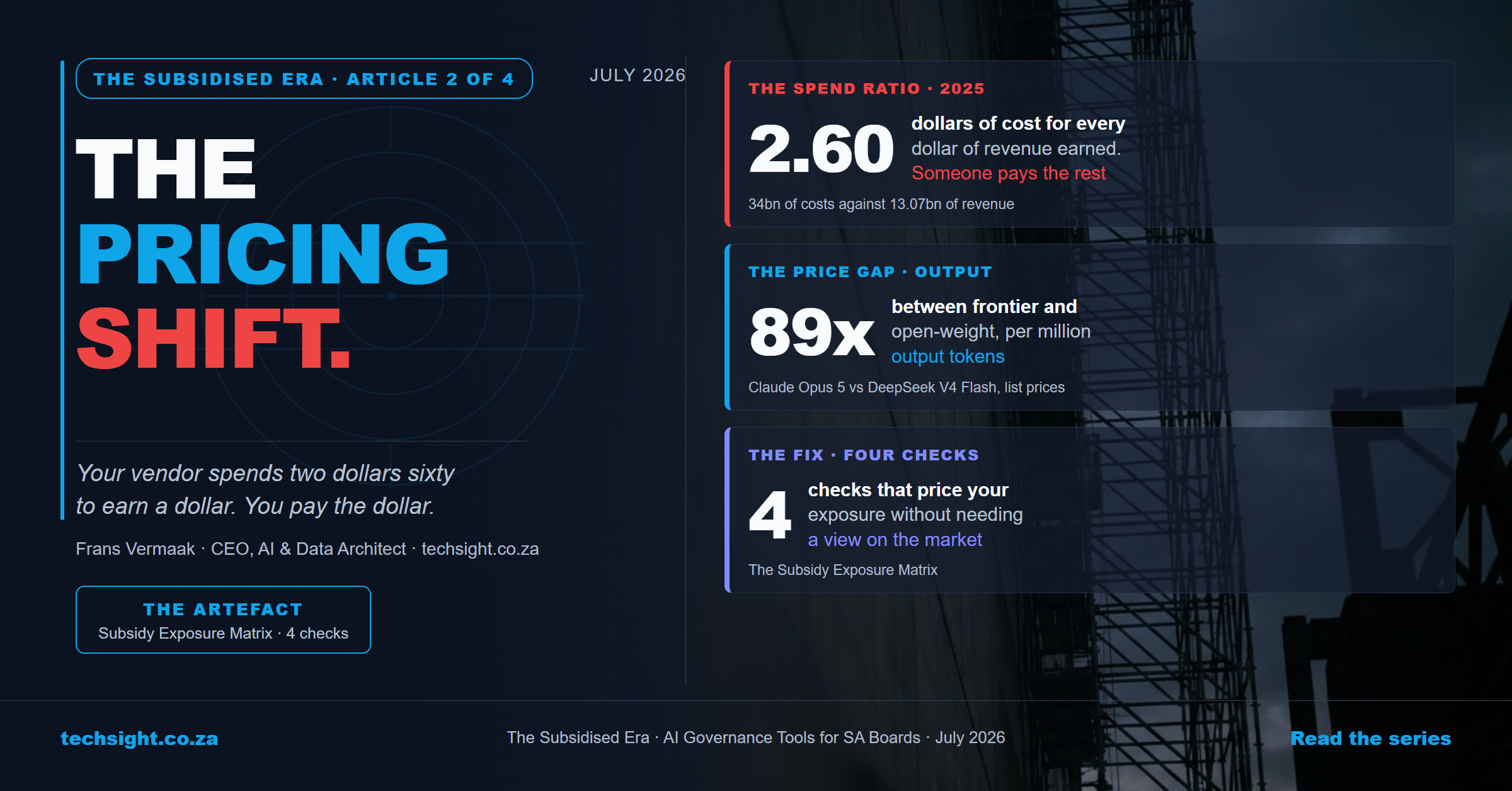
Your AI vendor spends about two dollars sixty to earn a dollar. You are paying the dollar. The exposure on your balance sheet is not the crash, it is the day that stops.
There is a number in the last article that is worth pulling out and putting somewhere permanent.
OpenAI's audited 2025 accounts, obtained by Ed Zitron and independently verified by the Financial Times, show total costs and expenses of 34 billion dollars against revenue of 13.07 billion. That is roughly two dollars sixty going out for every dollar coming in.
You are the dollar coming in. Somebody else is currently covering the one sixty.
That is not an accusation, a prediction, or a moral position. It is a division. And it is the single most useful fact a board can hold about its AI programme, because it converts a vague anxiety about "the bubble" into a specific, priceable question: what does this cost when it costs what it costs?
The subsidy is not hidden, it is just not on your invoice
Every organisation running AI at scale today is buying inference below the cost of production. The money making up the difference comes from investors who expect to be repaid later, out of prices that have not been charged yet.
That is a completely normal thing for a growth industry to do. Cloud did it. Ride-hailing did it. Streaming did it, and then stopped doing it.
The mistake is not using subsidised compute. The mistake is building a permanent cost structure on a temporary price and never writing down which one you assumed.
What the price actually looks like when someone charges properly
You do not have to imagine the unsubsidised price. There is already a market showing what compute costs when the seller is not buying share with it.
Open-weight models from DeepSeek, Alibaba's Qwen and Z.ai's GLM run between 60 and 90 per cent cheaper than the flagship models from OpenAI and Anthropic. Take one pair on published list prices. A million input tokens costs 5.00 dollars on Claude Opus 5 and 0.14 on DeepSeek V4 Flash, a factor of about thirty-six. On output the gap widens: 25.00 dollars per million against 0.28, very nearly ninety times.
Some of that gap is quality, and anyone who tells you the models are interchangeable is selling something. But ninety times is not a quality gap. It is a strategy gap, and strategies change.
They change quickly, too. Anthropic released Claude Opus 5 on 24 July, positioned as approaching the performance of its own Fable 5 at half the per-token price: 5 and 25 dollars per million against Fable's 10 and 50. That is a frontier vendor halving the price of near-frontier capability inside a single release cycle. If your unit economics were built on last quarter's price list, they were built on something the vendor treats as a variable.
Enterprises have noticed. US firms routed more than 30 per cent of their OpenRouter tokens to Chinese open models every week from 8 February this year, against a twelve-month average near 11 per cent and just 4.5 per cent in the first half of 2025. The figure touched 46 per cent, and in one week in July it reached 57. Coinbase cut its AI spending by nearly half by moving to GLM 5.2 and Kimi 2.7, and its token consumption went up while it did so. The automation firm Lindy moved all of its traffic off Claude to DeepSeek.
While we are here: you may have seen that migration described as going "from 1 per cent to over 60 per cent." The real series is 4.5, then 11, then 30-plus, then 46, then 57 in a single week. The actual numbers are remarkable. They did not need rounding up at both ends, and the version that did the rounding is the version travelling fastest.
The exposure is repricing, not collapse
Here is where most board conversations go wrong. They frame the AI question as binary: does it crash or not. Then, since nobody can answer that, the question is deferred.
Repricing needs no crash. It does not even need bad news. It is what happens when a well-funded company decides it has bought enough market share and would now like a margin, which is the ordinary behaviour of every company that has ever existed.
The signals that this is already under way are visible and dull. Vendors have moved enterprise customers off flat-rate subscriptions onto usage-based billing, which shifts volume risk from the seller to you. Frontier tiers get more expensive while older models get cheaper. Rate limits tighten. None of that makes headlines, and all of it changes your unit economics.
A board that has modelled "what if our AI costs triple" has a plan. A board waiting to find out whether the bubble pops has a subscription to the news.
What switching does and does not solve
The obvious response to a repricing risk is to note that cheaper alternatives exist and move on. That is half a control.
Moving workloads to open-weight or lower-cost models genuinely reduces price exposure, and the organisations above have the savings to prove it. It also introduces a different set of questions that a South African board cannot wave through: where inference happens, which jurisdiction the processor sits in, what POPIA requires of that transfer, and whether the answer you give the Information Regulator is the same one your engineering team would give.
That is not an argument against switching. It is an argument for switching deliberately, with the data-governance work done first, rather than discovering the arrangement afterwards through an incident. Trading a cost exposure for a compliance exposure is a decision. Doing it by accident, because a team found a cheaper endpoint, is not.
The artefact: the Subsidy Exposure Matrix
Complete this. One page, per material AI workload, reviewed at every budget cycle. It does not require a view on the market, only on your own spend.
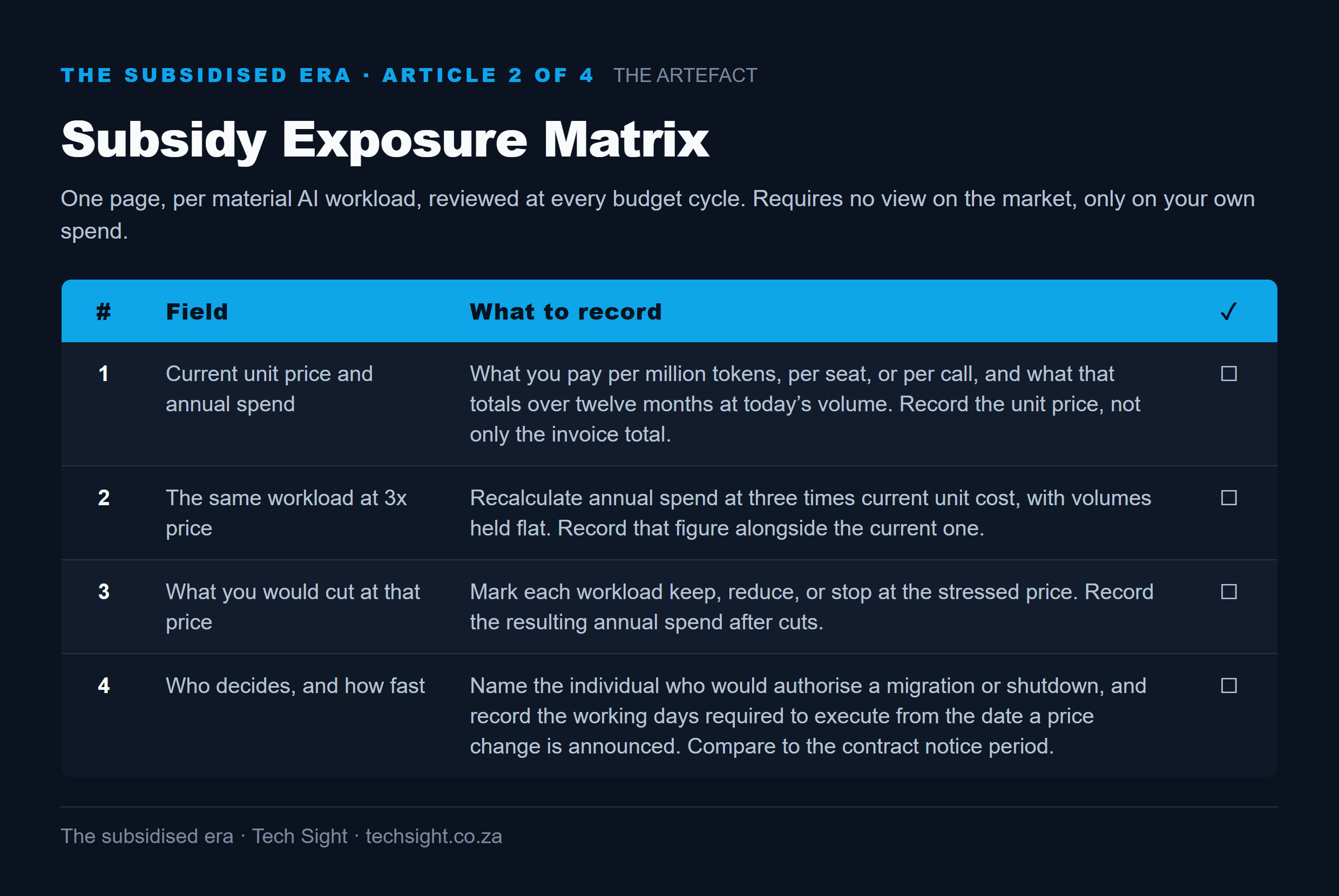
Current unit price and current annual spend. Record what you pay per million tokens, per seat, or per call, and what that totals over twelve months at today's volume. Record the unit price, not only the invoice total.
The same workload at three times the price. Recalculate annual spend at three times current unit cost, with volumes held flat. Record that figure alongside the current one.
What you would cut at that price. Mark each workload keep, reduce, or stop at the stressed price. Record the resulting annual spend after cuts.
Who decides, and how fast. Name the individual who would authorise a migration or shutdown, and record the working days required to execute it from the date a price change is announced. Compare that figure to the notice period in the contract.
How we hold ourselves to this
Tech Sight runs on frontier models we assume are priced below cost. That assumption sits in our risk register with a named owner and a stress-tested number beside it, and it is the reason our tooling is built to change model behind an interface rather than call one vendor directly.
We are not claiming immunity. We are claiming that when the price moves, we will already know what we are cutting, because we wrote it down on a quiet day rather than a loud one.
For the record
The subsidy has been the best deal in enterprise technology for three years, and taking it was correct. Organisations that refused to use AI until the pricing was proven sustainable have spent that period losing ground to organisations that used it and learned something.
The error is not in accepting a subsidised price. The error is in the quiet arithmetic that follows: building headcount plans, service levels and client commitments on a per-unit cost that exists because a venture capital fund is currently willing to underwrite it, and then never writing that assumption down anywhere a director could find it.
Somebody is paying one dollar sixty of every two sixty your AI programme consumes. You did not agree that arrangement, you cannot renew it, and you will not be consulted when it ends. All you get to decide is whether you found out on the day of the price change or the year before.
Sources: OpenAI audited 2025 financial statements as obtained by independent reporter Ed Zitron and independently verified by the Financial Times: revenue 13.07 billion US dollars, total costs and expenses 34 billion, giving a ratio of approximately 2.60 dollars of cost per dollar of revenue; comparative model list pricing as reported July 2026, with open-weight models from DeepSeek, Alibaba (Qwen) and Z.ai (GLM) priced approximately 60 to 90 per cent below flagship models from OpenAI and Anthropic; the specific pair cited is Claude Opus 5 at 5.00 US dollars per million input tokens and 25.00 per million output, against DeepSeek V4 Flash at 0.14 and 0.28 respectively, giving factors of approximately 36x on input and 89x on output; Anthropic released Claude Opus 5 on 24 July 2026 at 5.00 and 25.00 per million, unchanged from Opus 4.8 and positioned as approaching Fable 5 performance at half Fable 5's pricing of 10.00 and 50.00 per million. All list prices in this article were last confirmed on 29 July 2026; vendor list prices move, and readers should check the current published rates before relying on the ratios; OpenRouter routing data showing US firms sending more than 30 per cent of tokens weekly to Chinese open models from 8 February 2026, against a twelve-month average near 11 per cent and 4.5 per cent in the first half of 2025, peaking at 46 per cent and reaching 57 per cent in a single week in July 2026 (note: the widely circulated "1 per cent to over 60 per cent" formulation overstates both ends of this series); reported enterprise migrations including Coinbase reducing AI spend by nearly 50 per cent via GLM 5.2 and Kimi 2.7 with token consumption rising, and Lindy migrating all traffic from Anthropic Claude to DeepSeek; Protection of Personal Information Act 4 of 2013 (POPIA), section 72 (transborder information flows) and condition 7 (security safeguards); King V Code on Corporate Governance, IoDSA, Principle 10.
Book the two-hour diagnostic