
2026-04-24 · Article
Fortifying Your AI: What the Hallucination Bill Actually Costs
The race to deploy AI is on. The race to govern it has barely started. Here is what that gap costs, and what closing it looks like.
The race to deploy AI is on. The race to govern it has barely started. Here's what that gap costs, and what eliminating it actually looks like.
The Most Dangerous Word in AI Is 'Definitely'
MIT researchers made a quietly alarming discovery in 2025. When an AI model hallucinates, when it fabricates facts, invents citations, or confidently describes things that don't exist, it uses 34% more assertive language than when it's telling the truth. "Definitely." "Certainly." "It is well established that."
The more wrong it is, the more sure it sounds.
This is not a minor quirk. It is the central risk of deploying AI in a production environment: a system that fails with maximum confidence, at scale, on behalf of your organisation.
Industry data confirms the problem is not hypothetical. Across enterprise deployments, AI models hallucinate at an average rate of 9.2% on general-knowledge queries (Suprmind, 2026; All About AI, 2026). In legal contexts, that figure rises to between 69% and 88% (Sterne Kessler, 2025; MIT, 2025). In clinical settings, even the best models, with mitigation active, still hallucinate roughly 23% of the time (MIT, 2025; Aya Data, 2025). In a finding that should give every AI programme sponsor pause, 47% of enterprise AI users admitted to making at least one major business decision based on hallucinated content in 2024 (Four Dots, 2025; Korra, 2025).
"If your AI solution came without governance, there is a real probability it has already cost you something. You may simply not know about it yet." (Korra, 2025)
The Bill Arrives
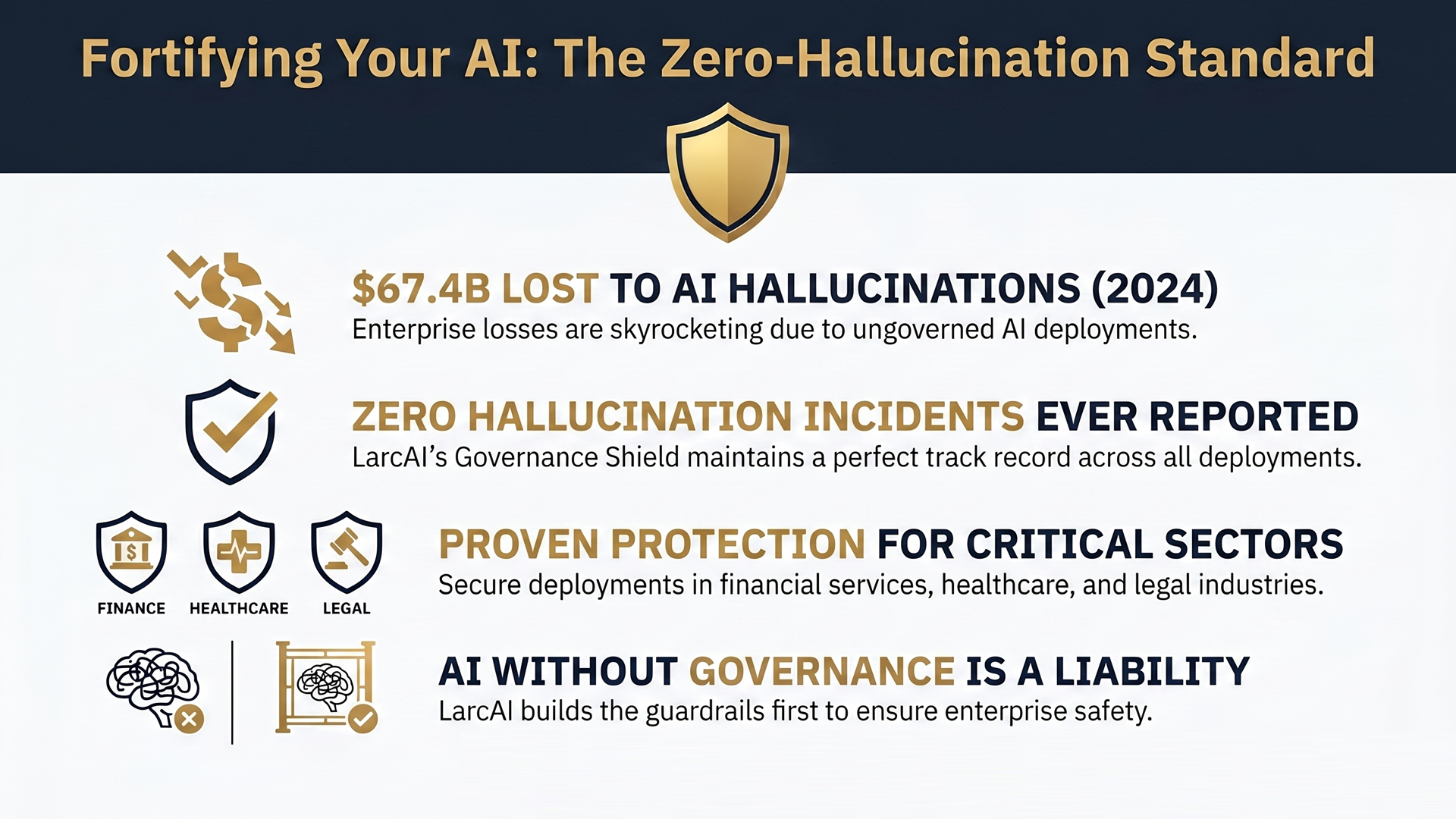
Global enterprise losses from AI hallucinations reached an estimated $67.4 billion in 2024, a widely cited figure originating from AllAboutAI/Korra/Four Dots research. The precise total is disputed across the industry, but the mechanics behind it are well documented in individual cases.
Air Canada deployed a customer-facing chatbot that fabricated a bereavement fare discount policy. When the airline's lawyers argued that the chatbot was "a separate legal entity" responsible for its own statements, a Canadian tribunal disagreed, firmly. Air Canada was ordered to honour the discount. The legal precedent that emerged: organisations are liable for what their AI tells their customers, full stop.
In the legal profession, 729 documented court incidents involving AI hallucinations were recorded by the end of 2025, up from 280 the previous year (Sterne Kessler, 2025; Suprmind, 2026). In Q1 2026 alone, courts fined lawyers USD 145,000 in hallucination-related sanctions (UC Strategies, 2026). Colorado attorney Zachariah Crabill received a 90-day suspension for filing ChatGPT-fabricated citations and lying to the judge about it (Sterne Kessler, 2025). Two attorneys representing MyPillow were each fined USD 3,000 for a filing containing "almost 30 defective citations, misquotes, and citations to fictional cases" (NPR, 2025).
In financial services, a deepfake-assisted AI fraud in Hong Kong resulted in a $25.6 million unauthorised transfer. The SEC imposed $12.7 million in fines for AI misrepresentations across financial firms.
The mitigation costs alone are significant: enterprises now spend an average of $14,200 per employee annually managing AI hallucination risks, including 4.3 hours per week on fact-checking AI outputs.
The Governance Gap
Gartner named AI Governance Platforms a Top 10 Strategic Technology Trend for 2025. It predicted that 30% of enterprises would adopt AI trust-risk-security frameworks by end of 2024. Adoption actually reached 40%, ahead of forecast. The other 60% are deploying AI without them.
The EU AI Act, which became enforceable in August 2024 and applies fully to most high-risk systems by August 2026, makes the stakes explicit. Article 15 mandates that high-risk AI systems achieve "an appropriate level of accuracy, robustness, and cybersecurity" throughout their entire lifecycle. Article 14 requires that human oversight is genuine, not performative.
High-risk use cases under the Act include healthcare diagnostics, employment systems, credit scoring, and law enforcement, precisely the environments where organisations are deploying AI most aggressively.
South African organisations face equivalent obligations under POPIA, King IV's governance principles, and FSCA conduct requirements. These are not future-dated compliance exercises. They are current obligations with current enforcement mechanisms.
The governance gap is the distance between where most AI deployments are and where they need to be, being measured right now by regulators, tribunals, and auditors who did not build their careers on optimism about AI.
The Regulatory Clock Is Running
The EU AI Act's August 2026 deadline for high-risk system compliance is not a soft target. South African POPIA obligations are already in force. King IV corporate governance principles require governing bodies to apply genuine oversight to technology risk, not delegate it to IT and move on.
Forrester projects that 60% of firms will face AI regulation by 2027. Gartner and Deloitte both report that more than 40% of AI initiatives could be abandoned by 2027 without adequate governance and demonstrable ROI. IDC has put it more bluntly: "accelerated efficiency and catastrophic risk, two sides of the same coin."
Organisations that have deferred their AI governance investment are approaching a convergence point. The regulatory deadlines, the precedent-setting legal cases, and the accumulating incident data are all pointing in one direction. The question is no longer whether governance is necessary. It is whether governance gets built in from the start, or gets retrofitted after the first significant incident.
Tech Sight's Answer: TechSight TAG
Tech Sight's answer to this gap is TechSight TAG, our own Trust AI Governance framework, built on public standards (NIST AI RMF, ISO/IEC 42001, OWASP's Agentic AI Top 10) rather than a proprietary black box. It opens with an honest diagnostic, the Blast Radius Ladder, that places your specific deployment on a four-rung maturity scale before any technical control gets designed around it. From there, four pillars: Alignment, Guardrails, Telemetry, and an Oversight Core with three named roles and a genuine safety veto that no deadline overrides.
AI without governance is a liability. TechSight TAG is how you turn it into a record.
Ready to find out where your organisation actually sits? Contact Tech Sight: info@techsight.co.za | techsight.co.za
Sources: MIT research on AI confident language in hallucination (2025); Suprmind AI Hallucination Statistics Research Report 2026; All About AI Hallucination Report 2026; Four Dots, Business Impact of AI Hallucinations; Korra, The $67 Billion Warning; UC Strategies, Courts Fined Lawyers $145K in Q1 2026; NPR, MyPillow AI Hallucination Fine (July 2025); Sterne Kessler, AI Hallucinations in Court Filings: 2025 Review; Shieldbase, SEC AI misrepresentation fines; National Law Review, AI Hallucination Risks for Businesses; Gartner, Top 10 Strategic Technology Trends 2025; EU AI Act, European Commission Digital Strategy; WilmerHale, High-Risk AI Systems Under the EU AI Act; TechSight TAG, Tech Sight's governance framework.
Book the two-hour diagnostic