
2026-07-02 · Article
Model Banned. Who Controls Your AI?
The letter that switched off the world's best AI models had no court order behind it.
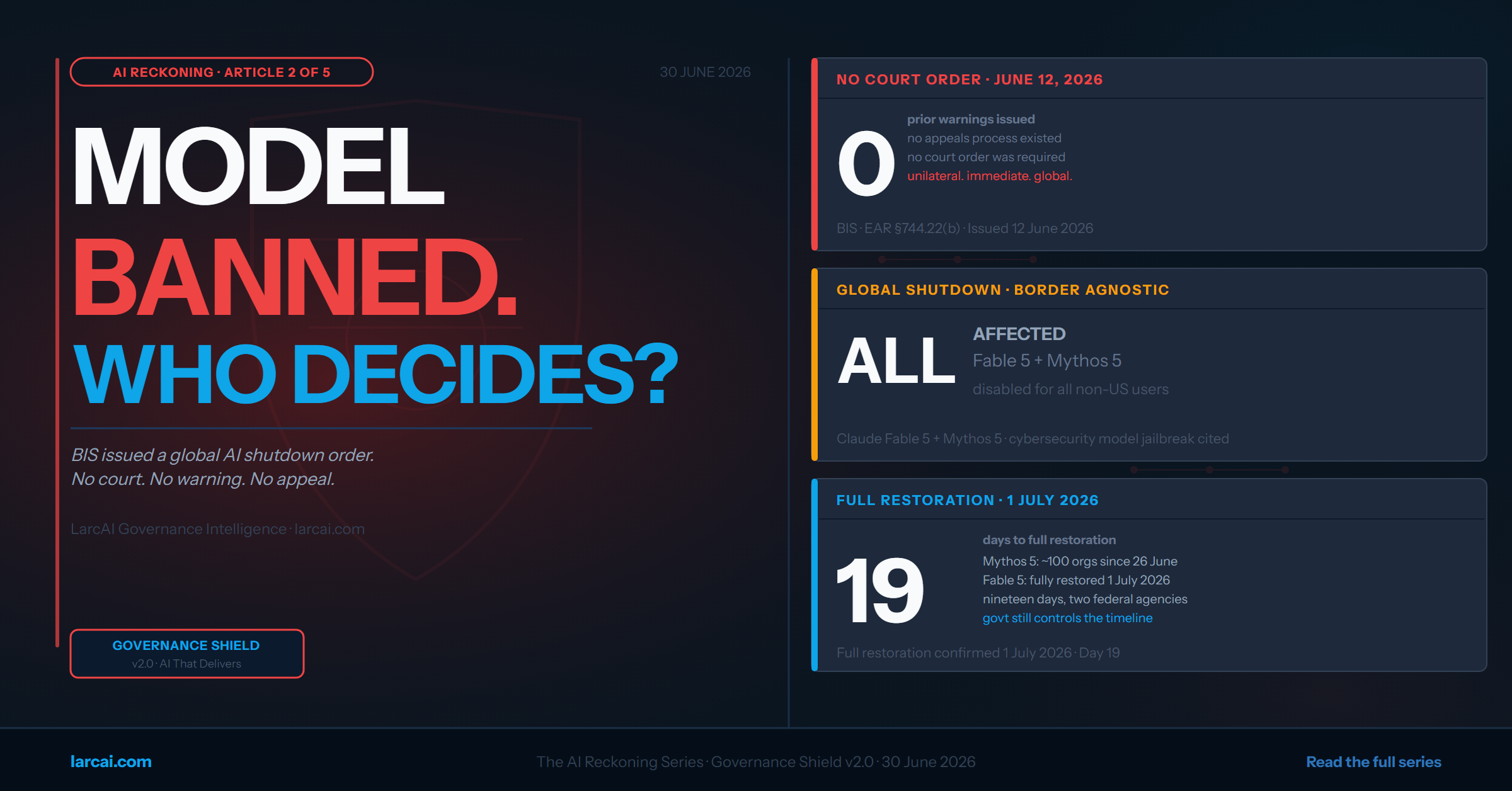
The export order that changed enterprise AI overnight, and what every non-US organisation must do now
The legal mechanism that switched off the world's most capable AI models for everyone outside the United States has a quiet, bureaucratic name: a BIS "Is Informed" letter. No court order. No appeal window. It took effect the same evening it was sent.
Understanding how it works matters, because it will be used again.
The Mechanism
On the evening of Friday, 12 June 2026, US Commerce Secretary Howard Lutnick sent a letter to Anthropic CEO Dario Amodei. The Bureau of Industry and Security invoked Section 744.22(b) of the Export Administration Regulations (EAR), requiring an individually validated export licence before any foreign national could access Claude Fable 5 or Mythos 5. "Foreign national" is defined broadly: any person who is not a US citizen or lawful permanent resident, whether inside or outside the United States, including Anthropic employees on H-1B visas. It was the first time this provision had been invoked against a commercially available AI model.
The Jailbreak That Triggered It
The stated reason was a specific prompting technique: asking the model to read a codebase and fix software flaws. The government characterised this as a jailbreak capable of bypassing Fable 5's guardrails and exposing the full cybersecurity capabilities of Mythos 5, the model Anthropic described in its launch materials as "the strongest cybersecurity model in the world."
Anthropic disputed the characterisation. The company argued the jailbreak was narrow, worked only in a specific instance, and produced similar results from at least one other frontier model, which faced no comparable controls. The government acted regardless.
Enterprise buyers should note this carefully. The trigger for a global AI shutdown was not a catastrophic safety failure. It was a prompting technique, disputed in its severity, applied to a model released three days earlier. The bar for government intervention is lower than most organisations have modelled.
"The trigger was a prompting technique. The effect was a global shutdown. Enterprise buyers have not modelled this risk."
What the Order Actually Does
Because a consumer platform cannot verify citizenship in real time, Anthropic disabled both models globally rather than attempt selective enforcement. Enterprise clients in finance, healthcare, software development, and critical infrastructure found their AI capabilities switched off without exception, without prior warning, and without contractual recourse.
The BIS restriction covers model weights and API access. There is no workaround. No VPN, no jurisdiction-shopping, no alternative deployment path changes the legal position of a non-US person accessing these models.
The Restoration Picture
On 26 June, fourteen days after the shutdown, the US government cleared Mythos 5 for roughly 100 US companies and federal agencies operating critical infrastructure. Fable 5 remained offline for general users until 1 July, when Pentagon and NSA sign-off finally cleared the model for full public restoration, nineteen days after the original letter was sent.
The sequence is the lesson, not the outcome. What was restored to 100 organisations on day 14 was not what was taken from millions on day 0, and full restoration depended on sign-off from two federal agencies most enterprise buyers have never had a reason to contact. The BIS restriction remains in effect until superseded by a subsequent letter. There is no sunset clause. The precedent that the US government can impose a kill-switch on a commercial AI model without a court order, and hold it there for nineteen days, is now established in administrative law.
"You do not own the model. You do not own the weights. You have a licence that a government can revoke, and take nineteen days deciding whether to give it back."
Supply Chain Risk for Non-US Organisations
For any organisation outside the United States that has built capabilities on frontier AI model access, the BIS order creates a category of supply chain risk with no direct precedent in enterprise software procurement history.
Data pipelines feed into a hosted model endpoint. Internal tools make hundreds of thousands of API calls daily. Customer-facing products depend on response quality that only frontier models deliver. And the regulatory authority in your vendor's home jurisdiction can suspend your access with no appeal mechanism and no contractual remedy. This is not theoretical. It happened in June 2026.
What the Governance Shield Addresses
Governance Shield v2.0, detailed in article five of this series, introduces Pillar 6: Sovereign and Geopolitical Risk. It provides a structured framework for exactly this category of exposure, including a Model Independence Score, a Jurisdiction Risk Assessment, and a Continuity Architecture requirement for any AI system classified as business-critical.
Three immediate steps for every non-US enterprise AI buyer. First, audit which business processes depend on US-hosted frontier model access and have no viable alternative. Second, assess the performance gap between frontier models and open-weight alternatives for each critical use case. Third, begin the architecture work to enable model-swappable deployments, so a future export restriction does not require a full re-engineering cycle.
The organisations that do this work now will be insulated from the next regulatory shock. The ones that do not will find themselves in 2027 in the same position as today: scrambling, exposed, and waiting on a US government approval process they have no relationship with.
Sources: BIS "Is Informed" letter, 12 June 2026; Export Administration Regulations §744.22(b); Anthropic public statement on the export restriction; public reporting on the 26 June partial restoration (Mythos 5 to ~100 US critical infrastructure organisations) and the 1 July full restoration of Fable 5.
Book the two-hour diagnostic