
2026-07-20 · Article
Nobody Caught Their Own
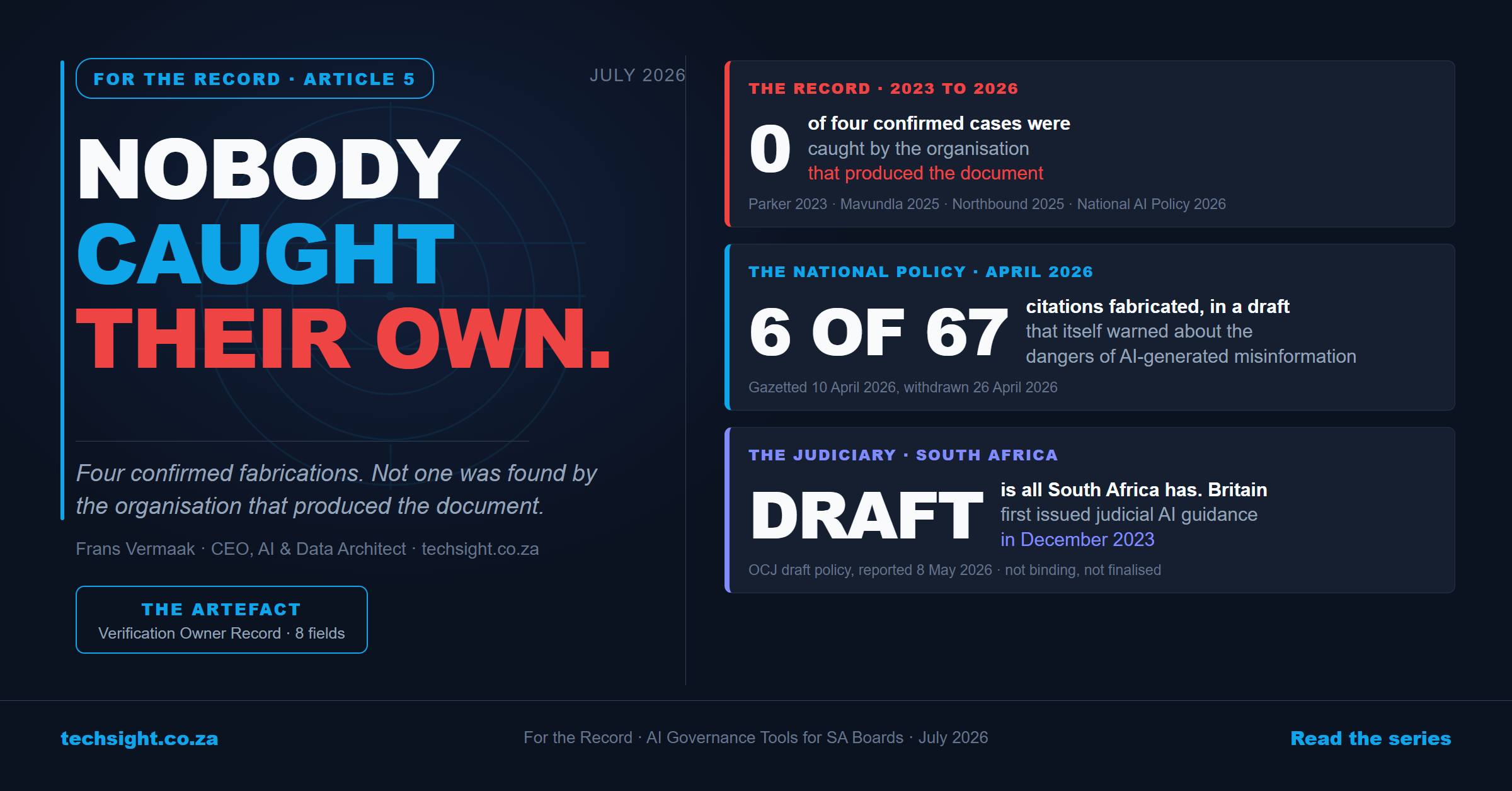
In every confirmed South African AI-fabrication case, the catch came from outside the party that produced the document. Not once from inside it.
This series was written as four. Article 1 treated the withdrawal of the draft National AI Policy as an incident report and ended with a vetting checklist. Read against the full South African record, that policy was not an outlier. It was one data point in a sequence running since 2023, and the sequence is climbing.
An attorney, then counsel, then a litigant in person, then the state, and now, allegedly, the bench. Five confirmed South African AI-fabrication incidents and one live allegation. In not one of the confirmed cases did the party that produced the document find the fabrication in it. Somebody downstream did, every time.
That is the finding worth a board's attention, and it is duller and more damning than the version usually told.
The record, in order
Parker v Forsyth NO, 1585/20, Johannesburg Regional Court, 29 June 2023, Magistrate Chaitram. The plaintiff's attorneys used ChatGPT for authority on a body corporate's right to sue for defamation. The authorities did not exist. No intent to mislead, the court found, before delivering the line quoted at every legal-tech conference since: the efficiency of modern technology, it held, still needs to be infused with a dose of good old-fashioned independent reading. Found by the opposing attorneys.
Mavundla v MEC: COGTA KZN, 7940/2024P, [2025] ZAKZPHC 2, Pietermaritzburg, 8 January 2025. Of the nine authorities counsel cited, two existed, and one of those was miscited. A fiction called "Pieterse v The Public Protector" had never been decided by anyone. The articled clerk said she had taken the cases from law journals via her university portal and denied using ChatGPT. Costs followed de bonis propriis, and the matter went to the Legal Practice Council. Found by Bezuidenhout J, while drafting.
Northbound Processing v SA Diamond and Precious Metals Regulator, 2025-072038, Gauteng High Court, 30 June 2025. Smit AJ was writing his judgment when he could not find two cases from the heads of argument, on points that, had they existed, could have been dispositive. Asked directly whether they were AI hallucinations, junior counsel Giles Barclay-Beuthin confirmed it appeared to be so. No deliberate attempt to mislead, the court expressly accepted. The team was referred to the Legal Practice Council. Smit AJ added a finding boards should read twice: it was irrelevant that the fabrications sat only in written heads, because judges rely on heads heavily and often more than on oral argument. Found by the judge, while drafting.
Roux v van Greunen, [2026] ZAGPJHC 55, Gauteng Local Division, 29 January 2026. A litigant appearing in person cited a case called "Matshoba v Acting Master of the High Court". It had never been decided. He conceded he had used, in his words, a few artificial intelligence systems. The court's line is the one to keep: Mr Roux "has been taken in by the artificial intelligence on which he relies". He did not disclose it. The judge found it.
The National AI Policy, gazetted 10 April 2026, withdrawn 26 April 2026. At least six of sixty-seven citations were fabricated, in a draft that itself dealt in part with the dangers of AI-generated misinformation. Minister Solly Malatsi said the most plausible explanation was that AI-generated citations had been included without proper verification, and that this should not have happened. He said the failure was not a mere technical issue but had compromised the integrity and credibility of the draft policy. Separately, he called it an unacceptable lapse that proved why vigilant human oversight of AI is critical. Found by News24 journalists, by the civic group Article One, and independently by the researcher Damien Charlotin.
Each step upward, the document carries more authority and passes fewer sceptical readers before it binds someone.
The uncomfortable detail
The tempting summary is that these were caught by opponents, by luck, by someone with an interest in the document being wrong. That summary is wrong, and the primary sources say so.
In Mavundla, Bezuidenhout J did not stumble on the fabrication. She checked her notes, had the chief stenographer replay the court recording to confirm exactly which citation counsel had given, and then put two High Court law researchers onto every authority in the list. That is not luck. That is a deliberate, resourced verification procedure, and it worked. Smit AJ did the same on his own initiative in Northbound.
So the verification layer is not missing from the system. It is missing from one specific place in it.
The court that received these documents had a procedure and applied it. The chambers that filed them had a sense-check. The institution doing the reading verified. The institution doing the writing did not. Every catch in the record came from a reader downstream: an opponent, three judges, journalists, a civic group, an academic. Not one came from the desk the document was written on.
That is the control gap. Not "nobody is checking". Somebody is checking. It is just never the person who made the thing, and by the time the checking happens the document has already been filed, gazetted, or handed down.
The fifth, stated carefully
In 2026, in a maintenance appeal before the Gauteng High Court in Johannesburg concerning two minor children, an appellant alleged that up to eleven references in a judgment by Acting Judge Themba Khaba could not be verified and might be hallucinated. That count and that characterisation are the appellant's. One disputed citation is rendered "Lubbe v Volkswagon (sic) SA" (2023) 4 All SA 289 (C) at para 75; lawyers searching for it reported finding only a Volkswagen SA tax dispute with SARS. A full court heard the appeal. Judgment was reserved. No finding has been made. Acting Judge Khaba has not publicly responded, and has not been shown to have used AI.
Two things must be said plainly, because the reporting has mostly not said them.
The appellant's evidence included AI-detection software returning "high risk in terms of citation integrity". AI-detection software is not evidence. It is widely documented as unreliable and produces false positives on ordinary human writing. A board that would not accept a lie-detector printout should not accept this one.
And a wrong citation is not proof of AI. Miscitation, clerk error and copy-paste drift are older than the profession's word processors, let alone its language models. The inference from bad citation to machine authorship is the appellant's. No court has drawn it.
So the allegation may come to nothing, and on what has been published it should be treated as unproven. That does not weaken the argument. It is the argument.
Where the allegation lands
Every South African enforcement action on AI fabrication so far has run down one channel: against practitioners, via the Legal Practice Council, using a judge's duty under Article 16(1) of the Code of Judicial Conduct (GN R865 of 2012, issued under section 12 of the Judicial Service Commission Act 9 of 1994) to report serious professional misconduct. Northbound invoked it expressly, and held the referral mandatory rather than discretionary. Mavundla referred on the same footing, via the registrar. The channel works.
There is no equivalent live channel for the bench. The Office of the Chief Justice released a draft Policy on Artificial Intelligence for the Judiciary for comment around April 2026, reported on 8 May 2026. It would bar AI from adjudicative functions, evaluating evidence, assessing credibility, interpreting and applying law, generating legal reasoning, and bail or sentencing, and would require judicial officers to disclose any material contribution of generative AI, naming the tool and its contribution. Sensible. Still a draft. Not binding.
The allegation lands in that hole. If it is well founded, no finalised instrument covers it. If it is unfounded, and it may well be, the hole is still there, waiting for the next one. The institution has no mechanism to catch its own, and none to clear its own either. An acting judge who did nothing wrong has no process that says so.
The comparison is unflattering, though it needs stating fairly. Measured to today, the Americans have had interim guidance from the Administrative Office of the US Courts since 31 July 2025, about twelve months. The British updated their AI Guidance for Judicial Office Holders on 31 October 2025, about nine, and that guidance reaches clerks, judicial assistants and legal advisers, and states that judicial office holders are personally responsible for material produced in their name. Both of those are softer instruments than they sound: the American one is expressly interim, the British one is guidance rather than rule. The fairer comparison is harsher still. The UK first issued judicial AI guidance in December 2023. On that clock South Africa is not nine months behind. It is closer to two and a half years.
The delegation gap
One detail lifts cleanly out of the judicial story and into your own organisation, and it needs no allegation about anyone.
In both American cases where a federal judge's opinion came off the docket over fabricated content, the judge did not use the AI. Judge Julien Neals, District of New Jersey, withdrew a CorMedix opinion on 23 July 2025; a law-school intern had used ChatGPT, without authorisation and contrary to chambers policy. Judge Henry Wingate, Southern District of Mississippi, removed a DEI temporary restraining order he had issued on 20 July 2025 and substituted a corrected version signed on 22 July; his clerk had used Perplexity. Both accounted for it in October 2025 under Senator Grassley's inquiry. Neals's chambers policy, it emerged, had been verbal. He has since put it in writing.
The most senior name on the document was not the person who used the tool. The control that failed was not technological. It was an instruction to a junior and an assumption it had been followed.
South Africa has its own version of this, in the case list above, and it is closer to home than the American ones. The sense-check in Northbound was not junior counsel's. Senior counsel Arnold Subel SC told the court he had relied on an experienced legal team and had done a sense-check on the heads before they were filed. The senior name on the document was not the person who used the tool. The senior's only control was an unrecorded read-through. That is Neals's control, in a Johannesburg chambers, and it failed the same way.
If your AI policy lives in a conversation you had with your team, you have Neals's control.
What the vertical tool is actually selling
Barclay-Beuthin was not using a general chatbot. The tool was Legal Genius, which the court recorded as being put forward as trained exclusively on South African legal judgments and legislation. Domain-specific. Locally trained. Exactly what is being pitched to your legal department this quarter as the safe alternative to ChatGPT.
It hallucinated. Its own site tells users the tool can make mistakes and to verify facts, especially citations.
Note what that disclaimer does commercially. Fine-tuning on a narrow domain did not remove the failure mode. It lowered the user's guard on the exact step that catches it, which is worse. And it moved the liability to the buyer in one sentence on a web page. That trade sits inside every vertical AI product your board is being sold: the vendor takes the revenue, the buyer takes the verification duty, and the disclaimer is the receipt. Perfectly legal. Just be clear you signed it.
King V's Principle 10, effective for financial years beginning on or after 1 January 2026, puts technology and AI governance on the governing body, and its human-oversight duty is expressly commensurate with the level of risk. It does not require sign-off on every AI output. It requires you to have decided where the proportionate line sits. A citation in a document that binds someone sits on the far side of it in any reading.
The artefact: the Verification Owner Record
File this. One record per AI-assisted document leaving the organisation. Not a policy. A row with a name in it, dated, before release. Article 1 gave you the checklist of what to verify. This is the answer to who, and it is the thing that was missing on the producing side every single time.
Document and version. The exact artefact certified, so the record cannot be attached retrospectively to another draft.
AI assistance declared. Drafting, summarising, research, references, data. Domain-specific tools are not exempt, and have the worse record.
Reference list, itemised. Every external reference, one line each. Not a count. The list.
Verified against primary source, by name. Per reference: the named human who opened the actual source and confirmed it exists and supports the claim made. A search result is not a primary source. A tool's confidence score is not a primary source.
Date verified. Before release, not after the complaint.
Delegation trail. If verification went to a junior, an assistant or a clerk: who did it, and who is accountable for it. Usually not the same person. Both American cases and one South African one turned on that gap.
Unverifiable items. Anything unresolved. The document does not leave with an open row. This is the field with teeth, because it is the one people want to skip at 6pm.
Accountable owner. The director or delegated executive whose name is on the document's integrity under Principle 10. One name, not a committee.
Fifteen minutes, filed with the version it certifies. Set that against a withdrawn national policy, two costs referrals and a judgment under challenge.
For the record
These cases are usually told as a story about lawyers being careless with a new tool. That reading is comfortable and wrong. Look at where the catching happened, every time. The courts had a procedure. The producers had a sense-check. No firm, no chambers and no department of state in this country has yet found its own fabricated content before an outsider did. The two matters that sit outside those categories do not rescue the pattern, they extend it. A litigant in person was caught by the judge who read his papers. And the allegation now attached to a judgment came from the side that lost, not from the court that produced it.
That is not a detection system. It is a detection system pointed the wrong way, sitting downstream of the damage, and staffed by people who owe you nothing.
The allegation against an acting judge may fail, and it should be presumed to until a court says otherwise. It has already made the useful point. The higher a document sits, the fewer readers are positioned to check it, and the more it costs when the checking finally happens somewhere else.
Whose name is on the step that catches what the machine made up? Not whose team. Whose name.
Sources: Parker v Forsyth NO, case 1585/20, Johannesburg Regional Court, Magistrate Chaitram, 29 June 2023 (sources differ on the costs outcome, which is therefore not stated); Mavundla v MEC: Department of Co-operative Governance and Traditional Affairs, KwaZulu-Natal, 7940/2024P, [2025] ZAKZPHC 2, KZN High Court Pietermaritzburg, Bezuidenhout J, 8 January 2025, including the court's record of the stenographer replay and the referral of every cited authority to two High Court law researchers (the court's holding that reliance on AI for legal research is irresponsible and downright unprofessional is a general proposition, not a characterisation of any party's conduct); Northbound Processing (Pty) Ltd v The South African Diamond and Precious Metals Regulator, case 2025-072038, Gauteng High Court, Smit AJ, 30 June 2025, including the court's express acceptance at para [95] that there was no deliberate attempt to mislead, the account of the Legal Genius tool as put before the court, and senior counsel's evidence as to the extent of his pre-filing review; Legal Genius disclaimer as published at legalgenius.co.za, checked 17 July 2026; draft South Africa National AI Policy, Government Gazette 10 April 2026, withdrawn 26 April 2026, ministerial statement of Minister Solly Malatsi (quotations are two separate statements, not a single passage); News24 investigation into fabricated citations, April 2026, with independent verification by researcher Damien Charlotin; reporting on an appellant's allegations in a Gauteng High Court maintenance appeal before Acting Judge Themba Khaba, full court, judgment reserved, no finding made and no public response at the time of writing, via Netwerk24/Rapport, 16 May 2026, and IBA Legalbrief Africa, 18 May 2026; Office of the Chief Justice, draft Policy on Artificial Intelligence for the Judiciary, released for public comment circa April 2026, reported 8 May 2026, not binding and not finalised at the time of writing; Administrative Office of the US Courts, interim AI guidance, 31 July 2025; Courts and Tribunals Judiciary (England and Wales), AI Guidance for Judicial Office Holders, 31 October 2025 update, first issued December 2023; withdrawn opinion of Judge Julien Neals (D.N.J., 23 July 2025) and the removed and replaced order of Judge Henry Wingate (S.D. Miss., issued 20 July 2025, corrected version signed 22 July 2025), with both judges' explanations to Senator Chuck Grassley, Senate Judiciary Committee, October 2025; Code of Judicial Conduct, GN R865 of 18 October 2012, issued under section 12 of the Judicial Service Commission Act 9 of 1994, Article 16(1); King V Code on Corporate Governance, IoDSA, launched 31 October 2025, Principle 10 (data, information and technology governance; human oversight commensurate with the level of risk), effective for financial years beginning on or after 1 January 2026; Tech Sight, "How a National AI Policy Was Withdrawn", For the Record Article 1, and the AI-Output Vetting Checklist, techsight.co.za/insights/articles/a-national-ai-policy-withdrawn.html.
Book the two-hour diagnostic