
2026-06-30 · Article
The $7.6 Trillion Bet
The industry needs twelvefold revenue growth to break even. History has one precedent for a gap this size.
And why the maths have never, not once, added up
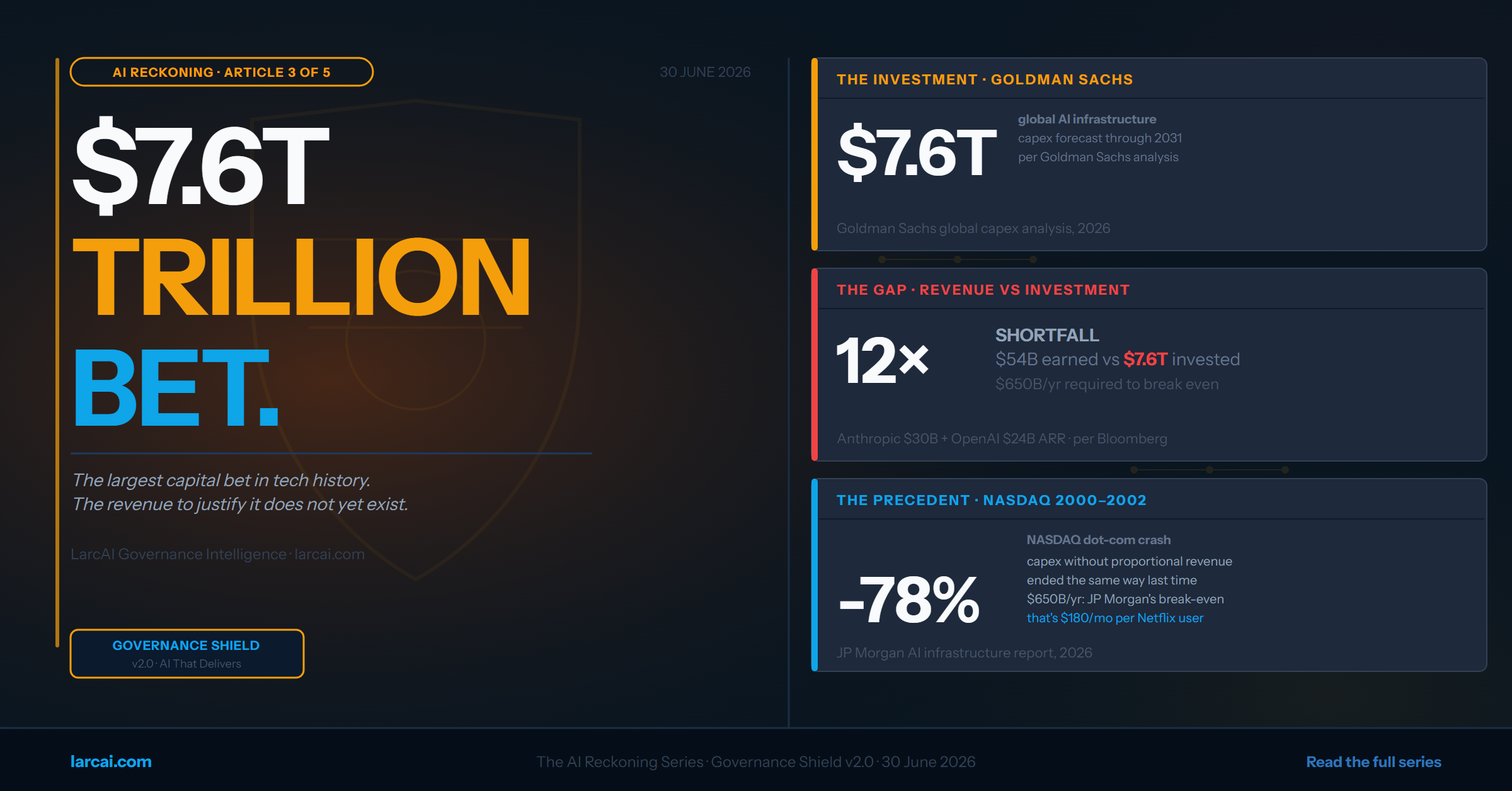
Goldman Sachs is projecting $7.6 trillion in AI infrastructure spending through 2031, according to its global capex analysis. JP Morgan says the industry needs $650 billion in annual revenue to justify it. The industry currently produces $54 billion. None of this is a reason to abandon AI. It is a reason to think carefully before building on a vendor whose economics require a twelvefold revenue expansion to break even.
Here is the comparison that rarely makes the conference keynotes.
JP Morgan's $650 Billion Problem
Anthropic crossed $30 billion in annualised revenue in April 2026, growing 80-fold in 27 months, per figures disclosed to investors. OpenAI is tracking near $24 billion, per Bloomberg. Combined: approximately $54 billion. Extraordinary growth by any measure of software company history. JP Morgan still needs the two largest model providers to grow more than twelvefold by 2030 for the infrastructure investment to make financial sense.
JP Morgan frames the scale with useful concreteness. $650 billion in annual AI revenue is the equivalent of collecting $180 per month from every Netflix subscriber on earth, in perpetuity. Or $35 per month from every iPhone user on earth. JP Morgan's 2026 AI infrastructure report states plainly: "Our biggest fear would be a repeat of the telecom and fibre buildout experience, where the revenue curve failed to materialise at a pace that justified continued investment."
"$650 billion in annual AI revenue needed. $54 billion currently produced. The gap is real, the timeline is tight, and the historical precedent is uncomfortable."
Goldman Sachs research noted on 2 June 2026: "The economics of artificial intelligence are more questionable today than two years ago." Goldman is projecting the infrastructure spend while its own research desk questions whether the returns arrive on the required timeline. The bank is, in effect, pricing both sides of the same bet.
The Dot-Com Pattern
The historical analogy that makes most AI investors uncomfortable is the one that fits most precisely. The internet was real. E-commerce was real. The transformation of every industry by networked computing was real. The NASDAQ still fell 78% between March 2000 and October 2002.
It fell not because the technology was wrong, but because the investment thesis required revenue growth rates that took fifteen years to materialise, not five. Amazon is worth more today than every company that went public in 1999 combined. The investors who bought Amazon at its 1999 peak waited until 2007 to recover their capital.
The pattern is not "AI is worthless." The pattern is "AI investment has significantly outrun AI revenue, and the only historical precedent for a gap of this scale involved a painful correction before the long-term value was realised."
What Happens When the Music Stops
Enterprise AI buyers need to understand what a correction scenario looks like on the vendor side. Model providers operating at negative unit economics depend on continued capital access. OpenAI projects $14 billion in losses for 2026. When capital markets tighten, the options are few: raise prices sharply, reduce model quality, narrow product offerings, or find an acquirer.
Vendor stability is not a soft consideration for enterprise AI. It is a governance requirement. An AI system whose vendor ceases to operate, pivots its product, or becomes inaccessible due to financial pressure is technical debt in the making. The kind that was always preventable.
"An AI vendor that ceases to exist is not a technology problem. It is a governance failure that was always preventable."
The $7.6 trillion bet will eventually pay off. The organisations that maintain governance discipline through a correction will be the ones running reliable AI systems when it does.
Sources: Goldman Sachs global AI capex analysis; JP Morgan AI infrastructure report, 2026; Anthropic investor disclosures (per Bloomberg); OpenAI revenue figures (Bloomberg); The Information on OpenAI 2026 loss projections; NASDAQ historical data (dot-com correction 2000-2002).
Book the two-hour diagnostic