
2026-07-28 · Article
The OpenAI Loss Discrepancy: Reading an AI Vendor's Accounts Before Someone Reads Them To You
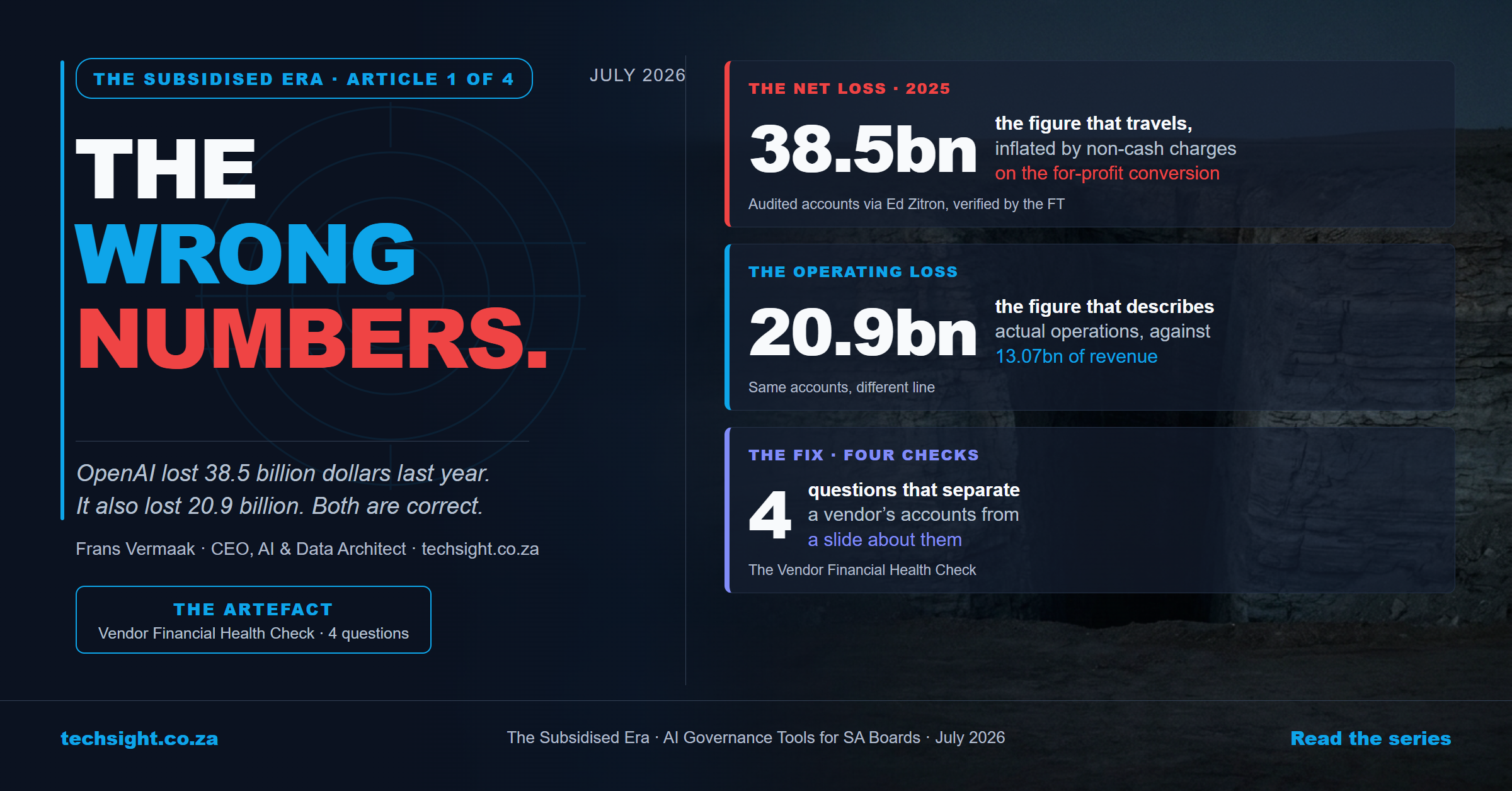
OpenAI lost 38.5 billion dollars last year. It also lost 20.9 billion. Both are correct, and the gap between them is where your next procurement decision goes wrong.
Someone is going to bring OpenAI's losses to your board this quarter. They will arrive with a number, a tone, and a recommendation already attached, and the number will be wrong in a way nobody in the room can check.
Not invented. Wrong in the more interesting way: real, sourced, and describing something other than what the person quoting it thinks it describes.
Two true numbers
Independent reporter Ed Zitron obtained OpenAI's audited 2025 financials, independently verified by the Financial Times. Revenue of 13.07 billion dollars. Operating loss of 20.92 billion. Net loss of 38.5 billion.
Read those last two again. They differ by roughly 17.6 billion dollars, which is more than the company's entire revenue for the year.
That difference is not operations. It is non-cash accounting arising from the company's conversion out of nonprofit control, principally a 41.55 billion dollar charge tied to changes in the fair value of convertible interests and warrant liabilities, partly offset by other items. Those are real entries in a real set of audited statements. They are not money that left the building, and they do not recur.
So when a slide says OpenAI "burned 38.5 billion dollars," the number is genuine and the verb is fiction.
None of which makes the underlying position comfortable. Total costs and expenses came to 34 billion dollars against 13.07 billion of revenue, which is roughly two dollars sixty out for every dollar in. That is a serious number. It does not need the help.
And that is the part worth sitting with, because the inflation was unnecessary. Someone took a figure that was already alarming and made it more alarming, and in doing so handed every reader a defensible reason to dismiss the whole argument. The exaggeration did not strengthen the case against OpenAI. It insured OpenAI against the case.
The report everyone cited and nobody finished
In July, the news outlet NOTUS obtained a draft report from inside the US Treasury. Career analysts had concluded that AI firms are more deeply entrenched in the American economy than their dot-com predecessors, and that a downturn would carry through equity markets, private credit, data-centre financing, cloud providers, chip manufacturers and utilities.
That is a genuinely significant document, and it is being quoted accurately as far as it goes.
It stops going quite early. Treasury told NOTUS the findings were unvetted. The analysts themselves recorded that many leading AI companies are more mature, more profitable, and hold stronger balance sheets than the speculative ventures of the late 1990s.
That caveat is not a footnote. It is the difference between "the government secretly knows it is 1999" and "some officials modelled a downside and noted the comparison is imperfect." One of those is a finding. The other is a headline wearing a finding's clothes.
Both sentences came from the same document. Only one of them travels.
Watch a number harden in real time
Yesterday, according to the BBC, chip stocks fell hard. South Korea's Kospi was halted by a circuit breaker and closed 10.8 per cent down. Samsung Electronics and SK Hynix each fell more than 13 per cent. Nvidia dropped 5 per cent and lost the title of world's most valuable listed company to Apple. Japan's Nikkei closed nearly 4 per cent lower.
If you want that to be the beginning of the correction, it reads beautifully as the beginning of the correction.
Now hold it next to two other facts from the same day. China's largest memory chip maker, CXMT, rose almost 470 per cent on its Shanghai debut. And the analyst the BBC quoted, Jun Bei Liu of Ten Cap, read the sell-off as investors taking profit, with reinvestment likely after the US holiday season.
A market in which capital flees AI does not simultaneously bid a memory-chip listing up nearly fivefold in an afternoon. Something is happening. "The bubble is bursting" is not a description of it.
There is one more thing in that BBC piece worth marking, because you are watching a statistic being born. Nvidia's fall followed a Wall Street Journal report that it is in talks to provide around 250 billion dollars to OpenAI for a data-centre project. In talks. Reported. The BBC contacted both companies; neither commented.
Give that figure three weeks. The qualifier will fall off first, then the attribution, and by September somebody will put "Nvidia is funding OpenAI to the tune of a quarter of a trillion dollars" on a slide, sourced to nobody, and it will be repeated by people who would never accept that provenance for a debtors book.
You have advance warning on this one. Note the date you first saw it and watch what happens to it.
What a board actually controls
None of this tells you whether there is a bubble, and a board that waits for that answer will wait past the point where the answer is useful. The question is narrower and answerable this week: what happens to you if the vendor underneath your AI programme reprices, retrenches, or gets acquired.
That question does not require a market view. It requires reading the accounts.
King V puts technology and information oversight on the board, proportionate to risk. A dependency whose failure you have not priced is a risk nobody has oversighted, and that remains true on the days the market goes up.
The artefact: the Vendor Financial Health Check
Run this. Four questions, applied to any AI vendor before a material commitment, and again at renewal. Fifteen minutes with the accounts beats a year of reacting to headlines about them.

Operating or net? Which loss figure is in front of you, and does the person quoting it know there are two? If they cannot tell you the difference without looking, they are relaying, not analysing, and you are one link further from the source than you thought.
Cash or accounting? Is this money that left the building, or a non-cash charge? Conversions, impairments and write-downs all produce enormous, genuine, non-recurring numbers. A vendor can post a catastrophic net loss and be in better cash health than one posting a modest operating loss.
Audited, leaked, or summarised? Audited statements, a journalist's copy of internal figures, and a third party's account of that journalist's reporting are three different evidentiary standards. All three get quoted in the same voice. Write down which one you have.
Who benefits from this number travelling? Every AI figure serves somebody's position. A vendor wants the losses read as investment. A competitor wants them read as insolvency. An adviser wants them read as a reason to commission further work. Ask what the person handing you the number would like you to do about it, then decide separately.
How we hold ourselves to this
Tech Sight sells AI governance, so the honest disclosure is that we run this check on our own suppliers, and it has changed decisions. We have declined to build a critical dependency on tooling we thought was excellent, on the basis of what the vendor's own filings said about its runway. We were not predicting anyone's failure. We were declining to be surprised by it.
We also carry the exposure this article describes. Our own stack runs on frontier models priced, we assume, below what they cost to serve. That assumption is in our risk register with an owner's name against it, which is the whole of the recommendation we would make to anyone else.
For the record
The comfortable reading of the last month is that the AI bubble is finally deflating and the sceptics were right. The equally comfortable opposite is that this is a healthy correction and the believers were right. Both are available, both come pre-packaged with statistics, and picking between them feels like analysis.
It is not. It is choosing which set of numbers to stop checking.
The 38.5 billion figure was not a lie. It was a true number that stopped being true somewhere between the accounts and the slide, and not one person in that chain did anything worse than fail to ask a follow-up question. That is how every number in this article will reach your board: accurately sourced, correctly transcribed, and quietly describing something else.
The bubble may pop. It may deflate slowly and bore everyone. It may keep inflating for another two years and make the sceptics look foolish. Your exposure to the vendor underneath your AI programme is identical on all three of those days, and it is knowable this week.
Sources: OpenAI audited 2025 financial statements as obtained by independent reporter Ed Zitron and independently verified by the Financial Times: revenue 13.07 billion US dollars (up from 3.7 billion in 2024), total costs and expenses 34 billion, operating loss 20.92 billion, net loss 38.5 billion. The roughly 17.6 billion difference between the operating and net figures arises from non-cash accounting on the company's nonprofit to for-profit conversion, principally a 41.55 billion charge tied to changes in the fair value of convertible interests and warrant liabilities, partly offset by other items (note: the operating and net figures are frequently conflated, and the phrase "burned 38.5 billion" misdescribes non-cash accounting charges as cash expenditure; note also that the 41.55 billion charge is larger than the 17.6 billion gap it partly explains, so the two should not be equated); leaked draft US Treasury Department report obtained by NOTUS, July 2026, assessing AI-sector entrenchment relative to dot-com era firms and transmission channels to equity markets, private credit, data-centre financing, cloud providers, chip manufacturers and utilities, with Treasury's statement to NOTUS that the findings were unvetted and the analysts' own recorded observation that leading AI firms are more mature, more profitable and better capitalised than late-1990s speculative ventures; BBC News, "Chip stocks slide in US and Asia as AI jitters rattle investors," 28 July 2026, reporting the Kospi circuit-breaker halt and 10.8 per cent close, Samsung Electronics and SK Hynix falls exceeding 13 per cent, Nvidia's 5 per cent decline and loss of most-valuable-listed-company status to Apple, the Nikkei 225 close nearly 4 per cent lower, CXMT's Shanghai debut rising almost 470 per cent, the Wall Street Journal report that Nvidia is in talks to provide approximately 250 billion dollars to OpenAI for a data-centre project (unconfirmed; BBC reported contacting both companies for comment), and the quoted assessment of Jun Bei Liu, founder of Ten Cap; King V Code on Corporate Governance, IoDSA, Principle 10 (data, information and technology governance; oversight proportionate to risk).
Book the two-hour diagnostic